15 Famous Landmarks in New York City That Define the World's Greatest Skyline


New York City is one of the most landmark-dense places on earth. Within the five boroughs, centuries of architectural ambition, cultural energy, and civic investment have produced a built environment unlike anything else in the world. From the gilded spire of the Chrysler Building to the steel cables of the Brooklyn Bridge, from a centuries-old public library guarded by stone lions to an 800-acre park at the heart of Manhattan — New York's famous landmarks are not background scenery. They are the city itself.
This guide covers 15 of the most iconic landmarks in New York City, with context on their history, architecture, and why each one is worth visiting in person.
1. Statue of Liberty
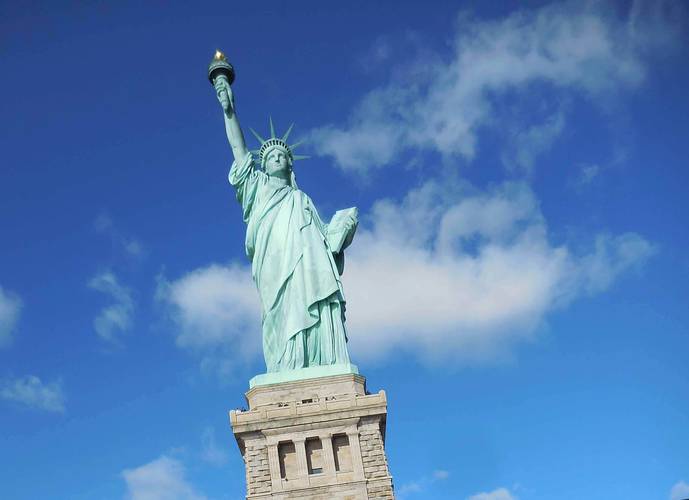
The Statue of Liberty stands on Liberty Island in New York Harbor, a gift from France to the United States dedicated in 1886. Designed by French sculptor Frédéric Auguste Bartholdi with the internal iron framework engineered by Gustave Eiffel, the statue depicts the Roman goddess Libertas holding a torch aloft and a tablet inscribed with the date of American independence. Its copper sheets, now oxidised to their iconic verdigris green, cover an iron armature that was revolutionary engineering for its time.
Visitors access the island by ferry from Battery Park in Lower Manhattan or from Liberty State Park in New Jersey. The pedestal houses a museum of the statue's history and construction, while tickets to the crown — available in limited numbers and sold out well in advance — provide extraordinary views over the harbour. The Statue of Liberty remains one of the most internationally recognised symbols in the world.
2. Empire State Building

The Empire State Building is perhaps the most famous skyscraper in the world. An Art Deco masterpiece completed in 1931, it held the title of the world's tallest building for nearly 40 years. Rising 443 metres to the roof (or 443 metres to the tip of the antenna), it stands in Midtown Manhattan and defines the city's skyline from virtually every approach. The building's tiered, setback design is a textbook example of Art Deco architecture at its most refined.
Two observation decks are open to the public: the Main Deck on the 86th floor offers open-air views in all directions, and the Top Deck on the 102nd floor provides a more intimate elevated vantage point. The building is illuminated in different colours for various holidays and events throughout the year, and it appears in over 250 films — more than any other building in the world.
3. Central Park
Central Park is one of the great urban achievements in American history. Spanning over 800 acres in the middle of Manhattan and running from 59th Street to 110th Street, it was designed by Frederick Law Olmsted and Calvert Vaux following a competition held in 1858. The park took roughly 20 years to complete, requiring the relocation of thousands of residents and the movement of millions of tonnes of earth and rock to create the naturalistic landscape that appears so effortless today.
The park contains lakes, meadows, woodlands, ice-skating rinks, a zoo, multiple playgrounds, outdoor theatres, and nearly 10,000 benches. It receives approximately 42 million visitors per year — more than Yellowstone, Yosemite, and the Grand Canyon combined. Walking, cycling, or simply sitting in the park on a clear afternoon is one of New York's most purely enjoyable experiences.
New York City offers some of the world's most celebrated experiences, and Traveloka's activities page has a broad range of tours and tickets to make the most of every day you spend there.
4. Chrysler Building
The Chrysler Building, completed in 1930, is widely regarded as the finest example of Art Deco architecture in New York — and possibly in the world. Designed by William Van Alen for the automotive magnate Walter Chrysler, the building is crowned by a distinctive stainless steel sunburst spire that gleams brilliantly in sunlight and catches the light of the city at night. Its eagle-headed gargoyles, inspired by Chrysler radiator caps, are among the most distinctive architectural details on any building in Manhattan.
At 319 metres, the Chrysler Building was briefly the tallest structure in the world when it was completed — a title it held for less than a year before the Empire State Building surpassed it. The building's lobby, clad in African marble and featuring elaborate Art Deco murals, is open to the public during business hours and is worth visiting in its own right.
5. Flatiron Building
The Flatiron Building is one of Manhattan's most distinctive and instantly recognisable structures. Built in 1902 and designed by architect Daniel Burnham, it occupies a triangular plot at the intersection of Fifth Avenue and Broadway near Madison Square, with a tapered edge as thin as just two metres at its narrowest point. The Beaux-Arts facade rises 22 storeys and wraps around its unusual site with a sculptural confidence that makes it look completely at home despite its odd shape.
The Flatiron District that surrounds the building has evolved into one of Manhattan's most fashionable neighbourhoods, with excellent restaurants, independent retailers, and easy access to both Madison Square Park and Union Square. The building itself is best appreciated from across the street or from Madison Square Park, where the full drama of its triangular form is visible.
6. Grand Central Terminal
Grand Central Terminal is more than a transport hub — it is one of New York's great public spaces. The Beaux-Arts structure, designed by the firms Reed and Stem and Warren and Wetmore and completed in 1913, handles over 750,000 visitors per day across its 44 platforms, making it the largest rail terminal in the world by number of platforms. Its Main Concourse is 90 metres long and 37 metres wide, with a vaulted ceiling painted with a constellation mural in cerulean blue.
The terminal was saved from demolition in the 1970s following a landmark legal battle, and a major restoration completed in 1998 returned it to its original grandeur. The lower concourse is home to the celebrated Grand Central Market and dozens of restaurants and food stalls. Commuters, tourists, and New Yorkers all share the space in a way that feels genuinely democratic.
7. New York Public Library
The Stephen A. Schwarzman Building — the main branch of the New York Public Library — sits on Fifth Avenue between 40th and 42nd Streets, its marble facade guarded by two famous stone lions nicknamed Patience and Fortitude. Designed by the architectural firm Carrère and Hastings and completed in 1911, it is one of the finest Beaux-Arts buildings in the United States. The Rose Main Reading Room on the third floor, stretching nearly 90 metres in length with 15-metre ceilings and original chandeliers, is among the most beautiful interior spaces in New York.
The library holds one of the most important research collections in the world, including the Gutenberg Bible and original manuscripts by Charles Dickens and George Washington. Entry is free, and the library is open to the public six days a week. The adjacent Bryant Park, which wraps around the library's rear, is one of the most pleasant public spaces in Midtown.
8. Rockefeller Center
Rockefeller Center is a complex of 19 commercial buildings spread across 22 acres in Midtown Manhattan, built between 1930 and 1939 and designed primarily by architect Raymond Hood. It stands as the largest private building project in American history at the time of its construction and a defining statement of Art Deco urbanism. The complex is centred on the 70-storey 30 Rockefeller Plaza tower, home to the Top of the Rock observation deck, which offers some of the best elevated views in the city including an unobstructed look at the Empire State Building and Central Park.
The famous outdoor ice-skating rink at the centre of the complex opens each autumn and is synonymous with the New York Christmas experience, anchored by the annual Christmas tree lighting that draws hundreds of thousands of spectators. NBC Studios, the Radio City Music Hall, and dozens of restaurants and retailers complete the complex's offering.
9. Brooklyn Bridge
The Brooklyn Bridge spans the East River between Lower Manhattan and Brooklyn Heights, and it remains one of the most beautiful pieces of civil engineering in American history. Designed by John Augustus Roebling and completed in 1883 after 14 years of construction, it was the world's longest suspension bridge at the time of its completion. Its two Gothic-arch stone towers rise 85 metres above the river, supporting a web of steel cables that carry both vehicle traffic and a celebrated pedestrian and cycling walkway.
Walking across the Brooklyn Bridge is one of New York's essential experiences. The timber-planked pedestrian path runs down the centre of the bridge above the traffic lanes, offering exceptional views of Lower Manhattan's skyline, the harbour, and the surrounding waterfront. The walk takes roughly 30 to 45 minutes end to end and is particularly stunning at sunrise or in the golden light of late afternoon.
10. Times Square
Times Square is New York's most visited neighbourhood and one of the most commercially intense public spaces on earth. The intersection of Broadway and Seventh Avenue in Midtown Manhattan is defined by its towering digital billboards, which cover entire building facades and remain illuminated 24 hours a day. It is estimated that around 330,000 pedestrians pass through Times Square daily, making it one of the busiest public spaces in the world.
The neighbourhood is the heart of New York's theatre district, with Broadway shows in venues on and around the square drawing millions of theatregoers annually. The New Year's Eve ball drop has taken place here since 1907, attracting up to a million people to ring in the new year. Whatever your relationship with crowds and neon, Times Square warrants at least one visit for the sheer, relentless energy of it.
11. Washington Square Park
Washington Square Park is the social and cultural heart of Greenwich Village, anchored by a triumphal arch designed by Stanford White and completed in 1895 to commemorate the centenary of George Washington's inauguration as president. The park's central fountain, surrounded by a ring of London plane trees, is one of the most recognisable gathering spots in the city and a perpetual stage for musicians, chess players, skateboarders, and students from nearby New York University.
The park is particularly lively on weekends and in the warmer months, when the fountain becomes a de facto swimming hole for children and the surrounding benches fill with a cross-section of New York life. The surrounding streets of Greenwich Village offer some of the best independent dining, bookshops, and architecture in Manhattan.
12. Madison Square Garden
Madison Square Garden sits at 34th Street and Seventh Avenue in Midtown Manhattan and has been the site of some of the most significant sporting and entertainment events in American history. The current circular arena — the fourth to carry the name — was designed by Charles Luckman and opened in 1968 above Penn Station. It seats approximately 20,000 for concerts and hosts the New York Knicks NBA franchise and the New York Rangers NHL franchise as resident tenants.
Beyond sport, Madison Square Garden has hosted an extraordinary range of landmark concerts, from Elvis Presley and The Beatles to more recent sold-out runs by global artists. Arena tours are available on non-event days, providing behind-the-scenes access to locker rooms, the playing surface, and production areas.
13. Chelsea Market
Chelsea Market occupies a full city block between Ninth and Tenth Avenues in the Meatpacking District, housed within the former National Biscuit Company factory complex where the Oreo cookie was invented in 1912. The industrial building was converted into a gourmet food market and retail destination in the 1990s, and it remains one of the best places in New York to eat, browse, and people-watch under one roof. Exposed brick walls, steel beams, and repurposed factory equipment give the interior a warm industrial aesthetic.
The market houses dozens of independent food vendors, restaurants, and specialty retailers, with a strong emphasis on quality and provenance. It sits at the base of the High Line, the elevated park built on a disused freight railway above the West Side, making it a natural starting or finishing point for a High Line walk.
14. Queens Botanical Garden
The Queens Botanical Garden in Flushing offers a serene counterpoint to the density of Manhattan's landmarks. Covering 39 acres, it was originally developed for the 1939 World's Fair and redesigned by David Benkert into its current form. The garden features herb and fragrance collections, rose gardens, a sustainable urban agriculture demonstration, and quiet ponds that attract birds throughout the year.
It is one of the more peaceful and undervisited green spaces in New York City, popular with local families and anyone looking for a calmer alternative to Central Park. The surrounding neighbourhood of Flushing is also home to one of the best concentrations of Chinese and Korean food in the entire United States, making a visit to the garden easy to combine with a serious dining excursion.
15. Gantry Plaza State Park
Gantry Plaza State Park in Long Island City, Queens, sits directly across the East River from Midtown Manhattan and offers some of the most dramatic skyline views available anywhere in the five boroughs. The park takes its name from the large industrial gantries that once loaded railcar floats on the Hudson River waterfront and have been preserved as structural landmarks within the park. Designed by Thomas Balsley, the park opened in 1998 and spans a long stretch of riverside green space with piers, lawns, and public art.
The view from the park's piers — with the Empire State Building, Chrysler Building, and United Nations headquarters reflected in the water — is one of the great unsung panoramas in New York. The adjacent neighbourhood of Long Island City has developed rapidly into a vibrant destination in its own right, with galleries, restaurants, and direct subway connections to Midtown and Downtown Manhattan.
Book Your Trip with Traveloka
New York City rewards every type of traveller, and getting there from Australia is straightforward when you have the right app. Traveloka is Southeast Asia's leading travel platform, trusted by over 100 million users across Asia and beyond, offering Australian travellers a simple way to compare and book flights and hotels for international travel.
Once your flights are sorted, browse hotels across Manhattan, Brooklyn, and the outer boroughs to find accommodation that suits your style and budget. Arrange airport transfer from JFK or Newark in advance to make your arrival seamless, and consider car rental if you plan to explore beyond the city limits. Check Traveloka promotions for the latest deals on flights and hotels to make your New York trip even better value.
Download the Traveloka app from the Google Play Store or Apple App Store to plan your New York City visit with ease.
Discover flight with Traveloka
Tue, 15 Sep 2026

JetBlue Airways
Los Angeles (LAX) to New York (JFK)
Start from AU$226.92
Wed, 23 Sep 2026

China Airlines
Jakarta (CGK) to New York (JFK)
Start from AU$614.79
Sat, 12 Sep 2026

Gulf Air
Bangkok (BKK) to New York (JFK)
Start from AU$694.31

Tags:
new york
Recommended Articles

15+ Free Things to Do in New York in 2026 (No Budget, No Problem)

Which New York Pass is the Best for Me?
10 Best Museums in New York City

What Are the Must-Try Street Foods in New York? Find Out Here!

Ultimate Halal Guide and Tips to New York City’s Boroughs

6 Best Museums in NYC (Must Visit!)
Explore the Best of New York City

New York City

Manhattan

Brooklyn