7 Best Historical Sites in India: From the Taj Mahal to the Caves of Ajanta


India's historical landscape is one of the most diverse and layered in the world, shaped by the Mughal Empire, ancient Hindu kingdoms, Buddhist monasteries, Rajput fortresses, and Dravidian temple traditions that evolved across different centuries and regions of an enormous subcontinent. The country holds over 40 UNESCO World Heritage Sites, including some of the most iconic buildings ever constructed, and its greatest monuments span a geographic arc from the desert forts of Rajasthan to the cave temples of Maharashtra and the ruined empires of Karnataka.
This guide covers seven of India's most significant historical sites, each one offering a distinct window into a different chapter of the country's long and layered history, with confirmed entry fees and practical tips for every visit.
1. The Taj Mahal, Agra
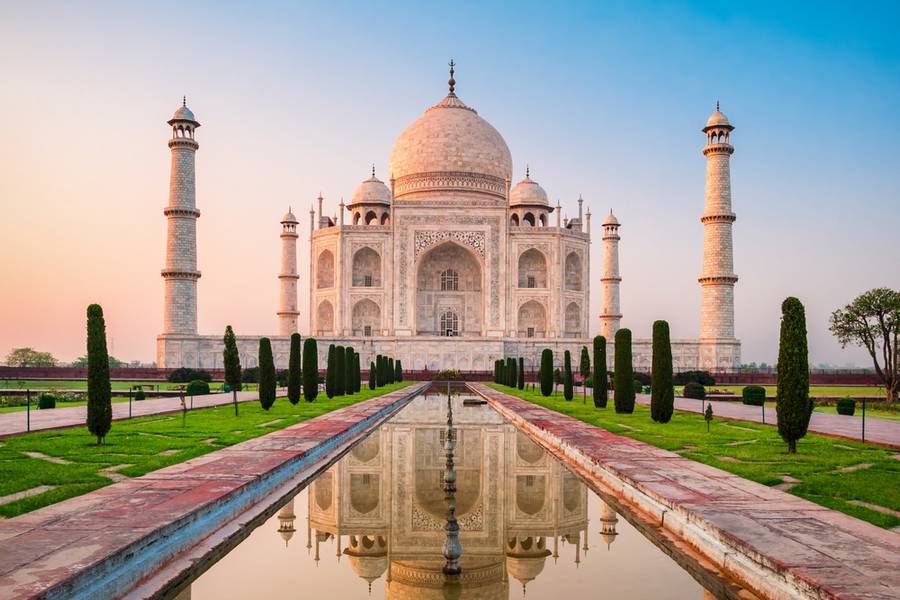
The Taj Mahal is the most celebrated building in India and widely regarded as the finest example of Mughal architecture in the world. Commissioned by Emperor Shah Jahan in 1631 as a mausoleum for his wife Mumtaz Mahal, who died during the birth of their fourteenth child, the complex was constructed over a period of approximately 22 years and completed in 1653. UNESCO inscribed the Taj Mahal as a World Heritage Site in 1983, and it is consistently ranked among the New Seven Wonders of the World. The complex stands on the southern bank of the Yamuna River in Agra, approximately 200 kilometres south of Delhi.
Architecture and the Marble Exterior
The main mausoleum is built from translucent white Makrana marble, quarried in Rajasthan, which changes colour subtly throughout the day — appearing pinkish at dawn, brilliant white at noon, and softly golden at sunset. The exterior surfaces are inlaid with pietra dura, a technique of setting semi-precious stones including lapis lazuli, carnelian, turquoise, and coral into carved marble recesses to form floral and calligraphic patterns. The central dome rises 73 metres above the base and is surrounded by four smaller domed chhatri pavilions; the four minarets flanking the platform were designed to lean very slightly outward so that in the event of collapse they would fall away from the tomb rather than toward it.
The Garden and Symbolic Design
The Taj Mahal complex is laid out according to the principles of the Mughal charbagh, a formal four-quartered garden divided by water channels representing the four rivers of paradise described in the Quran. The reflecting pool at the garden's centre provides the iconic view of the mausoleum mirrored in the still water — an effect best seen in the early morning before the crowds arrive and the wind disturbs the surface. The main gateway, the Darwaza-i-Rauza, frames the first view of the tomb perfectly as visitors enter, a deliberate compositional choice that creates the experience of revelation at the moment of entry. The overall symmetry of the complex is interrupted only at one point: Shah Jahan's own cenotaph, added after his death, sits slightly off-centre beside his wife's — the only asymmetry in the entire design.
Entry and Practical Information
Entry to the Taj Mahal complex costs ₹1,300 for foreign visitors; access to the interior of the mausoleum itself requires an additional ₹200. The site is open from sunrise to sunset every day except Fridays. Tickets must be purchased online through the Archaeological Survey of India's official booking system, and entry is managed in timed batches during peak hours. Arranging an airport transfer from Indira Gandhi International Airport in Delhi to Agra is the most practical way to begin an India itinerary that starts with the Taj — the journey by road takes approximately three hours depending on traffic.
Delhi's Indira Gandhi International Airport is India's main international gateway, served by direct connections from across Asia, the Middle East, and Europe. Compare flights to Delhi to secure the best fares and timing for your trip.
Discover Flights With Traveloka
Mon, 28 Sep 2026

Batik Air Malaysia
Kuala Lumpur (KUL) to New Delhi (DEL)
Start from USD 143.80
Wed, 30 Sep 2026
Batik Air Malaysia
Jakarta (CGK) to New Delhi (DEL)
Start from USD 190.02
Mon, 28 Sep 2026

SriLankan Airlines
Bangkok (BKK) to New Delhi (DEL)
Start from USD 172.26
2. Amber Fort, Jaipur

Amber Fort is the most spectacular of the six hill forts of Rajasthan inscribed collectively as a UNESCO World Heritage Site in 2013. Built primarily from 1592 under Raja Man Singh I of the Kachawaha Rajput clan on a ridge overlooking Maota Lake, the fort is a masterwork of Rajput military and palace architecture, combining Hindu and Mughal decorative styles in a series of interconnected courtyards, pavilions, and royal apartments spread across four levels. The fort is situated 11 kilometres northeast of Jaipur city and is reached by a steep ramp that climbs the rocky hillside above the lake.
The Sheesh Mahal — the Palace of Mirrors — is the most celebrated interior in Amber Fort. Its walls and ceiling are set entirely with small convex mirror fragments that catch candlelight and scatter it across the room in a simulation of a starlit sky; a single flame held in the room was said to be enough to illuminate the entire chamber. The Diwan-i-Am, or Hall of Public Audience, and the Diwan-i-Khas, Hall of Private Audience, are decorated with floral inlay work in semi-precious stones that approaches the quality of the Taj Mahal itself. Entry costs ₹1,000 for foreign visitors; the fort is open daily from 8:00 AM to 5:30 PM. Jaipur is approximately five hours from Delhi by road and three hours by express train.
3. Qutb Minar, Delhi

The Qutb Minar is the tallest brick minaret in the world and the centrepiece of the Qutb complex, the first major Islamic monument built in India after the establishment of the Delhi Sultanate. Construction of the minaret was begun in 1193 by Qutb ud-Din Aibak, the founder of the Sultanate, and the tower was completed and extended by his successors over the following century, ultimately reaching its current height of 72.5 metres across five tapering storeys. The red sandstone and marble exterior is inscribed with verses from the Quran in Arabic calligraphy and decorated with bands of geometric ornament. UNESCO inscribed the Qutb complex as a World Heritage Site in 1993.
The complex surrounding the minaret contains several significant structures, including the Quwwat-ul-Islam Mosque — the oldest mosque still standing in India — and the Iron Pillar of Delhi, a four-metre column cast in the 4th or 5th century AD that has stood in the open air for over 1,600 years without rusting, a metallurgical achievement that modern scientists still study. Entry to the entire Qutb complex costs ₹550 for foreign visitors, and children under 15 enter free. The site is open daily from 7:00 AM to 5:00 PM. The Qutb complex is located in south Delhi and is accessible by metro from the city centre in under 30 minutes.
4. Red Fort (Lal Qila), Delhi
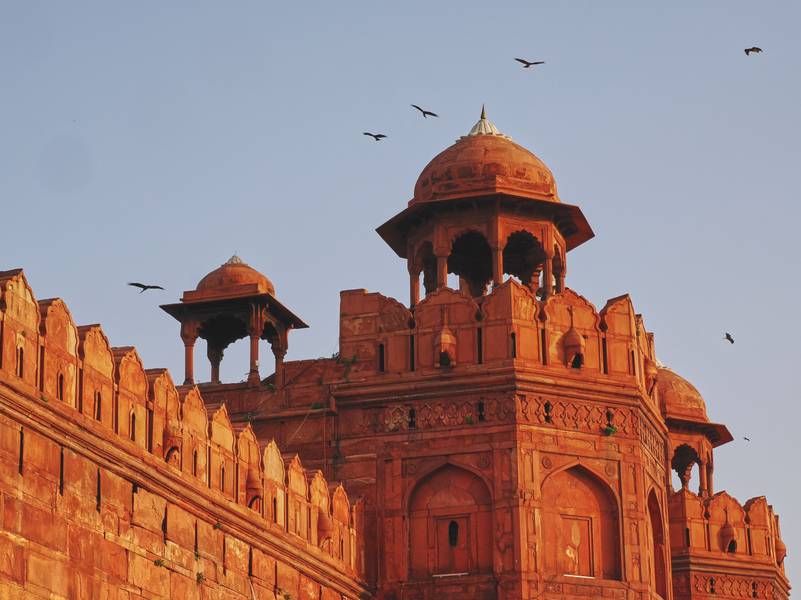
The Red Fort is the most important Mughal monument in Delhi and the political heart of the Mughal Empire at the height of its power. Built between 1639 and 1648 by Emperor Shah Jahan — who also built the Taj Mahal — the fort served as the main residence of the Mughal emperors for nearly 200 years, until the East India Company transferred power to the British Crown following the uprising of 1857. The fort takes its name from the massive red sandstone walls, averaging 10 metres in height along the exterior, that enclose a complex of marble palaces, gardens, and ceremonial halls spread across approximately 254 acres. UNESCO inscribed the Red Fort as a World Heritage Site in 2007.
Inside the walls, the Diwan-i-Am and Diwan-i-Khas served as audience halls for the emperor's public and private business respectively; the zenana, or women's quarters, was a self-contained world of palaces and gardens at the northern end of the complex. The fort is the site of India's Independence Day celebrations each year on 15 August, when the Prime Minister addresses the nation from its ramparts — a tradition maintained unbroken since independence in 1947. Entry costs ₹550 for foreign visitors; the fort is open Tuesday to Sunday from 9:30 AM to 4:30 PM, with the last entry at 4:00 PM. Delhi's wide range of hotels includes properties steps from the historic core of Old Delhi and modern options near Connaught Place — book early for the best locations and rates.
5. Fatehpur Sikri, Near Agra

Fatehpur Sikri is one of the most intact examples of Mughal imperial planning in existence — a complete walled city built by Emperor Akbar from 1569 and briefly serving as the capital of the Mughal Empire before being abandoned around 1610. Located 40 kilometres west of Agra, the city was constructed in red sandstone on a rocky ridge and included palaces, mosques, audience halls, and residential quarters for the emperor's court. UNESCO inscribed Fatehpur Sikri as a World Heritage Site in 1986. The reason for the city's abandonment remains debated among historians, with theories ranging from water scarcity to strategic military considerations.
The Buland Darwaza — the Gate of Magnificence — is one of the largest gateways in the world, built by Akbar to commemorate his conquest of Gujarat and rising 54 metres above the surrounding courtyard. It marks the entrance to the Jama Masjid, the great mosque of Fatehpur Sikri, within which stands the Dargah of Salim Chishti, the white marble tomb of the Sufi saint whose blessing Akbar credited with the birth of his son Jahangir. The royal palace complex across the ridge contains the Diwan-i-Khas, the Turkish Sultana's House with its extraordinary carved stonework, and the Panch Mahal, a five-storeyed open pavilion that caught the desert breeze across the emperor's garden. Entry is ticketed through the Archaeological Survey of India; the site is open daily from sunrise to sunset.
6. Ajanta and Ellora Caves, Maharashtra

Ajanta and Ellora are two of the greatest rock-cut archaeological sites in the world, located approximately 100 kilometres apart in the Aurangabad region of Maharashtra. The Ajanta Caves comprise 30 Buddhist monasteries and prayer halls carved into a horseshoe-shaped cliff face, created in two phases between the 2nd century BC and the 6th century AD. The cave interiors are covered in paintings and sculptures depicting scenes from the life of the Buddha and the Jataka tales of his previous incarnations; the murals are among the finest surviving examples of ancient Indian painting, with colours that remain vivid after fifteen centuries. UNESCO inscribed Ajanta as a World Heritage Site in 1983; entry costs ₹600 for foreign visitors, and the caves are open Tuesday to Sunday from 9:00 AM to 5:30 PM.
The Ellora Caves are a UNESCO World Heritage Site inscribed in 1983 and represent an even broader artistic tradition — 34 monasteries and temples carved from the same basalt cliff between the 6th and 11th centuries AD, covering Buddhist, Hindu, and Jain traditions in a single continuous site. The most extraordinary structure at Ellora is the Kailasa Temple in Cave 16, a monolithic Hindu temple carved entirely from a single mass of rock by working downward from the top — the entire two-storey structure, its courtyard, and its elaborate sculptural programme were freed from the surrounding cliff without a single foundation. Entry costs ₹600 for foreign visitors, and the site is open Wednesday to Monday from 6:00 AM to 6:00 PM.
From sunrise Taj Mahal tours and Old Delhi heritage walks to the Golden Triangle circuit connecting Delhi, Agra, and Jaipur, book your India activities in advance to secure the experiences that sell out first.
7. Hampi, Karnataka

Hampi is the ruined capital of the Vijayanagara Empire, which ruled much of southern India from the 14th to the 16th century and, at its height, was one of the largest and wealthiest cities in the world. The site covers approximately 36 square kilometres of boulder-strewn landscape along the Tungabhadra River in Karnataka, scattered with the remains of temples, elephant stables, market streets, royal enclosures, and bath complexes. UNESCO inscribed the Group of Monuments at Hampi as a World Heritage Site in 1986. The empire was sacked and largely abandoned following the Battle of Talikota in 1565, leaving the city in a state of dramatic ruin that has preserved it across the centuries.
The Vittala Temple complex is the architectural highlight of Hampi, containing the famous Stone Chariot — a shrine in the form of a temple chariot with stone wheels that once rotated — and the Musical Pillars of the main hall, 56 columns of granite that produce distinct musical notes when struck. Entry to the Vittala Temple complex costs ₹500 for foreign visitors; the surrounding ruins of the royal enclosure, the elephant stables, and the Virupaksha Temple precinct are largely free to explore. Reaching Hampi comfortably from other major cities requires a combination of train to Hospet and local transfer; hiring a car rental in Hospet or Bengaluru gives the flexibility to explore the widely spread ruins at your own pace over one or two full days.
Book Your Trip with Traveloka
India's historical sites span the full breadth of an enormous country, from the Mughal monuments of the north to the cave temples of Maharashtra and the ruined empires of the south. Planning a multi-destination itinerary is far more manageable when all your bookings are in one place. Traveloka, Southeast Asia's leading travel platform trusted by over 100 million users, covers international and domestic flights across India, hotels in Delhi, Agra, Jaipur, and Aurangabad, guided heritage tours from sunrise Taj Mahal visits to full Golden Triangle circuits, car rentals for exploring Karnataka and Maharashtra, eSIM data plans, and travel insurance — all within a single app.
Watch for Traveloka promotions for deals on flights and hotels for India travel. Download the Traveloka app — top-rated on the Google Play Store and Apple App Store across Southeast Asia — to start planning your India heritage journey today.
In This Article


Recommended Articles

Dubai in Summer 2026: What the Weather Is Really Like and How to Make the Most of It

Paris in Winter: Your Complete Weather and Travel Guide for 2026

Paris in Spring: What the Weather Really Feels Like (And Why It's Worth It)

Seoul in Autumn: Your Complete Guide to the City's Most Spectacular Season

London Summer Guide: Weather, Festivals, and the Best Things to Do in June, July & August
Osaka in Spring: Cherry Blossoms, Warm Walks, and Perfect Weather for Exploring