Mexico's 7 Greatest Historical Sites: From Aztec Pyramids to Maya Ruins


Mexico is home to 36 UNESCO World Heritage Sites, more than any other country in the Americas. Its archaeological record spans more than two millennia and encompasses civilisations as distinct as the Aztec, Maya, and Zapotec, each leaving behind monuments of astonishing scale and precision. From stone pyramids that aligned with celestial events to jungle-swallowed palace complexes and colonial city centres built directly on pre-Hispanic ruins, Mexico offers a depth of historical experience that few destinations in the world can match.
Whether you are flying into Mexico City, Cancun, or Oaxaca, the sites in this guide represent the best of what Mexico's ancient and colonial past has to offer. Each one is accessible to independent travellers, and all are open year-round.
Ready to plan your journey? Compare flights to Mexico City, Cancun, and Oaxaca to find the best fares for your travel dates.
Discover flight with Traveloka
Fri, 21 Aug 2026

China Airlines
Jakarta (CGK) to Mexico City (MEX)
Start from ₱ 46,718.72
Thu, 13 Aug 2026

United Airlines
Jakarta (CGK) to Mexico City (MEX)
Start from ₱ 62,845.46
Wed, 12 Aug 2026

All Nippon Airways
Jakarta (CGK) to Mexico City (MEX)
Start from ₱ 64,497.73
1. Teotihuacan: The City of the Gods

Located approximately 50 kilometres northeast of Mexico City, Teotihuacan is one of the most significant archaeological sites in the Western Hemisphere. Founded around 100 BCE, it grew into one of the largest cities in the ancient world, with an estimated peak population of over 100,000 people. The identity of the civilisation that built it remains one of archaeology's great open questions, as the city predates the Aztec Empire by several centuries. The Aztecs, who later settled the region, named it Teotihuacan, meaning "the place where the gods were created."
The Avenue of the Dead, a processional causeway stretching over two kilometres, forms the central axis of the site and connects its principal structures. The Pyramid of the Sun stands 65 metres tall and is the third-largest pyramid in the world by volume, visible from across the entire site. Climbing the pyramid is no longer permitted in order to protect the structure, but the view along the Avenue of the Dead from its base is equally commanding. At the far end of the avenue, the slightly smaller Pyramid of the Moon frames the northern end of the complex with striking symmetry.
The Temple of Quetzalcoatl, also known as the Temple of the Feathered Serpent, is the most decoratively detailed structure at the site. Its facades are covered in carved stone heads alternating between the feathered serpent deity and the goggle-eyed rain god, stacked in rows across multiple terraces. Teotihuacan has been a UNESCO World Heritage Site since 1987.
The site is open daily from 8:00 AM to 5:00 PM, with last entry at 4:00 PM. The entrance fee for international visitors in 2026 is 210 MXN (approximately USD 11). Arriving at opening time on a weekday gives you the Avenue of the Dead almost entirely to yourself before the tour groups arrive.
2. Chichen Itza: Heart of the Ancient Maya World

Chichen Itza is arguably Mexico's most globally recognised historical site, drawing over 1.7 million visitors annually. Located in the Yucatan Peninsula, the city flourished from around 600 CE and reached its political and architectural peak between the 9th and 10th centuries. In 2007, it was voted one of the New Seven Wonders of the World, and it has held UNESCO World Heritage Site status since 1988.
El Castillo, also known as the Temple of Kukulcan, is the centrepiece of the site. The pyramid stands 24 metres tall and features 91 steps on each of its four sides plus a single step at the top platform, totalling 365 steps that correspond to the days of the solar year. Twice a year, during the spring and autumn equinoxes, the sun casts a shadow along the northern staircase that resembles a descending serpent — an event that draws tens of thousands of spectators and reflects the extraordinary astronomical knowledge of Maya builders.
The Great Ball Court, at 168 metres in length, is the largest in Mesoamerica and features stone rings mounted high on the walls through which players drove a rubber ball using only their hips and elbows. The Temple of the Warriors and the Group of a Thousand Columns to its east demonstrate the scale of civic and ceremonial architecture beyond El Castillo. The Sacred Cenote, a natural sinkhole to the north of El Castillo, was used for ritual offerings and remains one of the most studied Maya sacred sites.
Chichen Itza is open daily from 8:00 AM to 5:00 PM, with last entry at 4:00 PM. The entrance fee for international visitors in 2026 is 697 MXN (approximately USD 35), paid in two separate portions at the federal and state fee windows at the entrance gate.
3. Historic Centre of Mexico City
The Historic Centre of Mexico City stands on the ruins of Tenochtitlan, the capital of the Aztec Empire, which was dismantled by Spanish forces under Hernán Cortés in 1521. The Zócalo, formally named the Plaza de la Constitución, is one of the largest public squares in the world at over 57,000 square metres, and it remains the ceremonial heart of the Mexican nation. A single UNESCO listing, granted in 1987, covers more than 1,500 buildings of historical significance within the centre's boundaries.
The Metropolitan Cathedral, which faces the Zócalo on its north side, is the largest cathedral in the Americas. Construction began in 1573 and was not completed until 1813, resulting in a facade that blends Gothic, Baroque, and Neoclassical styles within a single structure. Adjacent to the cathedral, the Palacio Nacional houses Diego Rivera's celebrated mural cycle depicting Mexican history from pre-Hispanic civilisation through to the modern era; entry to the palace is free of charge.
The Historic Centre rewards unhurried exploration on foot. The streets radiating from the Zócalo contain colonial government palaces, Art Nouveau post offices, and the remnants of Aztec infrastructure visible at street level in several locations. For practical information on current promotions when booking accommodation in the capital, check Traveloka promotions before your trip.
4. Templo Mayor: The Aztec Sacred Precinct
The Templo Mayor was the principal religious structure of Tenochtitlan and the spiritual centre of the Aztec Empire. The temple occupied what the Aztecs believed to be the precise centre of the universe, at the intersection of the four cardinal directions. It was dedicated to two deities simultaneously: Huitzilopochtli, god of war and the sun, on the south side, and Tlaloc, god of rain and agriculture, on the north. The ruins were only rediscovered in 1978 when electrical workers excavating beneath the streets of Mexico City unearthed an enormous carved stone disc depicting the dismembered moon goddess Coyolxauhqui.
The on-site Museo del Templo Mayor is widely regarded as one of the finest archaeological museums in Latin America. It houses over 7,000 artefacts recovered from the excavations, including the Coyolxauhqui Stone, a monolithic disc measuring approximately 3.25 metres in diameter. The museum also displays jade mosaic masks, ceremonial offering caches, obsidian blades, and terracotta figurines that together paint a vivid picture of daily and ritual life in Tenochtitlan.
The Templo Mayor is located just one block northeast of the Zócalo, making it a natural extension of any visit to the Historic Centre. The site is open Tuesday to Sunday from 9:00 AM to 5:00 PM and is closed on Mondays. Admission for both the archaeological zone and the museum is 95 MXN (approximately USD 5) per person.
Staying in the Historic Centre puts you within walking distance of the Templo Mayor, the Zócalo, and the Metropolitan Cathedral. Browse hotels in Mexico City across all price points to find the right base for your visit.
5. Monte Albán: Oaxaca's Zapotec Mountaintop Capital
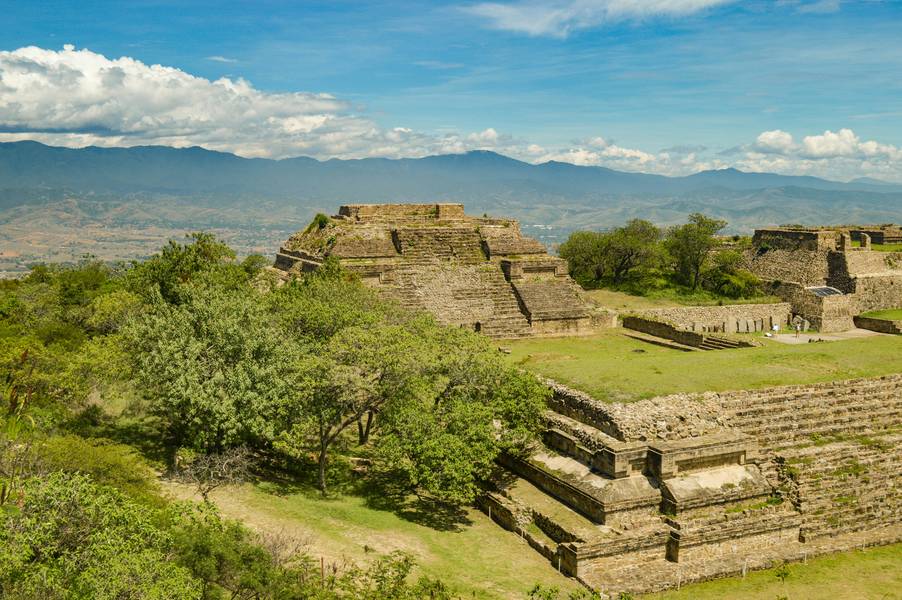
Monte Albán is the ancient capital of the Zapotec civilisation, built on a levelled mountain ridge that rises above the Valle de Oaxaca at an elevation of approximately 1,940 metres. Occupied from around 500 BCE to 700 CE, the city was one of the first true urban centres in Mesoamerica and reached an estimated population of 17,000 at its height. The Zapotec were one of the earliest peoples in the Americas to develop a writing system, and examples of their script appear on carved monuments throughout the site.
The central feature of Monte Albán is a large, flat plaza ringed by temples, platforms, and a ball court. The Building of the Dancers, known in Spanish as Los Danzantes, is among the most studied structures on the site. Its stone slabs are carved with human figures in unusual postures, which scholars now widely interpret as depictions of captives or sacrificial victims rather than the dancers that early researchers assumed. Underground, the site contains a series of Zapotec tombs decorated with painted murals and carved reliefs, several of which are open to visitors.
Monte Albán is located 9 kilometres from the city of Oaxaca and is most easily reached by organised tour or taxi. The site is open daily from 8:00 AM to 5:00 PM, and the entrance fee as of 2026 is 210 MXN (approximately USD 11), which includes access to the on-site museum. Monte Albán has been a UNESCO World Heritage Site since 1987.
6. Palenque: The Maya Palace of the Jungle

Palenque occupies a stretch of dense jungle in the state of Chiapas and is considered one of the most architecturally and artistically sophisticated Maya sites in Mexico. The city flourished from the 1st century CE to around 800 CE and reached its greatest heights under the ruler K'inich Janaab' Pakal, commonly known as Pakal the Great, who reigned for 68 years during the 7th century. The site covers 1,780 hectares, but fewer than 10% of its estimated 1,400 structures have been excavated, meaning much of the ancient city remains hidden beneath the jungle canopy.
The Palace, an irregular complex of buildings arranged around a four-storey tower, is the central landmark of the excavated zone. Unusually for a Maya city, a royal residential structure rather than a temple sits at the core of Palenque, reflecting the city's distinct political culture. In 1952, archaeologist Alberto Ruz Lhuillier discovered a hidden staircase inside the Temple of the Inscriptions that descended to the sealed tomb of Pakal, undisturbed since 683 CE. The tomb contained an intricately carved sarcophagus lid and a jade mosaic funerary mask, now among the most celebrated artefacts in the National Museum of Anthropology in Mexico City.
The sound of howler monkeys calling from the surrounding jungle is a constant backdrop at Palenque, and the combination of jungle setting, streaming water channels, and well-preserved carved reliefs makes it one of Mexico's most atmospheric sites to explore. Palenque has been a UNESCO World Heritage Site since 1987.
The archaeological zone is open daily from 8:00 AM to 5:00 PM, with last entry at 4:30 PM, and is closed on 1 January. The entrance fee is approximately 95 MXN. To explore guided activities across Mexico, including cultural tours and archaeological site excursions, browse the options below.
7. Uxmal: The Pyramid of the Magician

Uxmal (pronounced oosh-MAHL) is a Maya city located in the Puuc hills of Yucatan, approximately 80 kilometres south of Mérida. It flourished between 700 and 1,000 CE and is distinguished by its elaborate mosaic stonework and geometric friezes, a regional style known as Puuc architecture. Unlike many other Maya sites, Uxmal's monuments feature relatively few depictions of individual rulers, leading some scholars to suggest the city may have been governed by councils. It has been a UNESCO World Heritage Site since 1996.
The Pyramid of the Magician, which rises 35 metres above the main plaza, is distinctive for its elliptical base, which is unique in Maya architecture. The pyramid was built in five separate phases over several centuries, with each new temple encasing the previous one. Local tradition holds that the structure was erected overnight by a child with magical powers, a legend that persists in the region to this day. The steep staircase on the western face leads to a doorway framed by a giant stone mask of the rain deity Chaac.
The Governor's Palace, stretching 98 metres across a raised terrace, is frequently cited as one of the finest examples of pre-Columbian architecture in Mexico. Its upper portion features a continuous mosaic frieze assembled from approximately 20,000 individually cut stone pieces, depicting lattice patterns, stacked Chaac masks, and serpent motifs in extraordinary detail. The Nunnery Quadrangle, a four-building courtyard complex adjacent to the Pyramid of the Magician, offers an equally intricate display of Puuc decorative art across its four facades.
Uxmal is open daily from 8:00 AM to 5:00 PM. The entrance fee for international visitors in 2026 is 556 MXN (approximately USD 30), with a separate charge for the evening Sound and Light show, which runs seasonally.
Plan Your Visit to Mexico's Historical Sites
Best Time to Visit
The dry season from November to April is generally the most comfortable time to visit Mexico's archaeological sites. Temperatures are lower, rainfall is minimal, and conditions at open-air sites such as Teotihuacan, Monte Albán, and Chichen Itza are far more manageable. The summer months bring higher humidity, particularly in Chiapas and Yucatan, though the jungle greenery around Palenque is at its most vivid during and after the rainy season.
Peak visitor numbers at sites such as Chichen Itza and Teotihuacan coincide with both the equinoxes (late March and late September) and Mexican public holidays. Arriving at opening time on any day of the year remains the single most effective way to experience even the busiest sites without large crowds.
Getting Around Mexico
Mexico's historical sites are spread across multiple states, so planning your transport links is as important as booking the sites themselves. Domestic flights connect Mexico City to Oaxaca, Mérida, and Villahermosa (the nearest commercial airport to Palenque) in under two hours. For sites within day-trip range of major cities, such as Teotihuacan from Mexico City or Uxmal from Mérida, a car rental gives you the flexibility to control your arrival time and avoid group tour schedules.
For travellers arriving by air into Mexico City or Cancun, an airport transfer booked in advance provides a direct, comfortable connection to your hotel without the need to navigate local transport on arrival. Both airports serve as logical bases for multiple historical sites within their respective regions.
Entrance Fees and What to Know
All of Mexico's INAH-administered archaeological sites increased their entrance fees in January 2026. Carrying Mexican pesos in cash is strongly recommended at sites such as Chichen Itza and Uxmal, where card payment systems can be slow or intermittent. At Chichen Itza, the ticket is purchased in two separate stages at different windows, so allow extra time at the entrance gate. Most sites operate from 8:00 AM to 5:00 PM year-round, with last entry one hour before closing.
Traveloka is Southeast Asia's leading travel platform, trusted by over 100 million users across Asia and beyond. Booking your flights and hotels for Mexico through the app keeps all your travel details in one place, with competitive fares and a wide selection of accommodation from budget guesthouses to five-star city-centre hotels.
Book Your Trip with Traveloka
Planning a journey through Mexico's historical sites means coordinating flights into multiple cities, hotels near key sites, and ground transport between them. Traveloka makes that process straightforward: as Southeast Asia's largest online travel platform, trusted by over 100 million users, it brings flights, hotels, activities, car rentals, eSIM, and travel insurance together in a single app, so every part of your trip can be managed in one place.
For a Mexico itinerary, Traveloka lets you compare hundreds of flight options into Mexico City, Cancun, and Oaxaca simultaneously, then search accommodation near whichever sites you plan to visit first. The car rental category is particularly useful for a country where self-drive access significantly expands what you can reach independently. The app consistently offers competitive rates across all booking categories, and its straightforward search interface is built for travellers who want to move fast and book with confidence.
Download the Traveloka app on the Google Play Store or Apple App Store to start planning your Mexico trip today.
In This Article
Recommended Articles
Celebrate Racing and Culture at the Mexico City F1 GP

Ring in the New Year in Style: 7 Best Luxury NYE Getaways

Where to Honeymoon in 2026: 6 Best Luxury Destinations for Couples

7 best theme parks in Australia with epic rides

2026 Toyota AFL Grand Final: The Complete Melbourne Guide for Visitors

TCS Sydney Marathon 2026: The Complete Guide for Runners