China's Most Spectacular Da Ka Destinations to Visit in 2026


The term da ka — literally "to punch a card" — has become shorthand in modern Chinese travel culture for visiting a place so visually extraordinary that you simply must go, see it for yourself, and mark it as done. From skyline-defining landmarks along the Huangpu River to ancient cobblestone towns tucked into the Himalayan foothills, China's da ka destinations span an almost absurd range of landscapes, eras, and atmospheres. This guide brings together eight of the country's most spectacular spots, each verified as accessible to international visitors in 2026 and each offering a genuinely distinct experience. Whether you are planning your first trip to China or returning to tick off destinations you have long admired from afar, Traveloka makes it easy to arrange every piece of the journey in one place.
Discover Flights With Traveloka
Thu, 24 Sep 2026

China Southern Airlines
Kuala Lumpur (KUL) to Shanghai (SHA)
Start from RM 487.31
Tue, 22 Sep 2026
China Southern Airlines
Penang (PEN) to Shanghai (SHA)
Start from RM 504.55
Sun, 11 Oct 2026
China Southern Airlines
Kota Kinabalu (BKI) to Shanghai (SHA)
Start from RM 976.00
1. The Bund, Shanghai
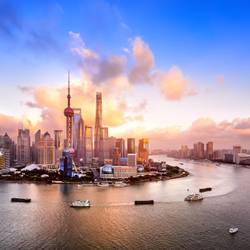
Few urban panoramas anywhere in the world match the theatrical contrast of Shanghai's Bund. On one side, a procession of grand early-twentieth-century buildings — formerly banks, trading houses, and consulates — stretches along the west bank of the Huangpu River in a mix of Baroque, Art Deco, and Beaux-Arts styles. On the other side, the futuristic skyline of Pudong rises in a forest of towers, with the Oriental Pearl Tower and the Shanghai Tower catching the light at every hour of the day. At dusk, both banks illuminate simultaneously and the river between them fills with cruise boats — making this one of the most dramatically scenic waterfront views on earth. The Bund is free to walk at any hour.
Wander south from the main Bund promenade into the former French Concession to find Wukang Road, a tree-lined boulevard of Art Deco residential buildings, independent cafes, and boutique shops. The curved facade of the Wukang Mansion at the top of the road — built in 1924 — is a spectacular backdrop for photography that draws visitors throughout the day. Book your hotels in the Jing'an or Xuhui districts to place yourself within easy reach of both the Bund and the French Concession.
2. Zhangjiajie National Forest Park and Glass Bridge
The quartzite sandstone pillars of Zhangjiajie National Forest Park, rising hundreds of metres from a deep-green valley floor in Hunan Province, provided the visual inspiration for the floating mountains in a celebrated science-fiction film — and seeing them in person confirms that the reality needs no embellishment. The park covers more than 300 square kilometres and contains over three thousand of these narrow, mist-wrapped columns. The Tianzi Mountain area offers the most dramatic elevated perspectives. International visitors can reach the park by high-speed train to Zhangjiajie City followed by a local transfer.
A short drive from the main park entrance, the Zhangjiajie Grand Canyon Glass Bridge spans 430 metres across a forested gorge, suspended 300 metres above the valley floor on 99 panels of triple-layered transparent glass. It remains the longest and tallest glass-bottomed pedestrian bridge of its kind and is fully open to international visitors in 2026, with real-name ticket registration required at booking. Together, the forest park and the glass bridge make a two-to-three-day itinerary in their own right.
3. Jiuzhaigou Valley, Sichuan
Jiuzhaigou Valley, a UNESCO World Heritage site in northern Sichuan, owes its extraordinary colour palette to calcium carbonate-rich water filtering through a series of interconnected lakes and waterfalls across a high-altitude valley system. The result is a succession of pools ranging from turquoise and jade to deep cobalt and milky white, each one reflecting the surrounding forest. The Shuzheng Lakes section and the lower half of Rize Valley — home to Five Flower Lake, Pearl Shoal Waterfall, and Nuorilang Falls — are fully open and accessible in 2026. Visitors should check the official park administration channels for the latest access status before travel.
The park operates under a strict daily visitor cap and requires advance online ticket purchase using passport details. Early morning entry gives the best chance of photographing the lakes in still, glassy conditions before foot traffic on the boardwalks disturbs the reflections. A combined visit with Chengdu — covered later in this guide — makes excellent use of the Sichuan leg of any China itinerary.
4. The Great Wall at Mutianyu, Beijing
Of all the restored Great Wall sections open to visitors near Beijing, Mutianyu is consistently ranked as the most rewarding for international travellers. The section stretches for approximately 2.25 kilometres along a granite ridgeline north of Beijing, its crenellated towers rising and dipping with the natural contours of the Yanshan Mountains. Forest covers both flanks of the wall for most of its length, meaning that even in summer the climb to the ramparts arrives through dappled shade. A cable car provides an alternative ascent for those who prefer to save energy for the walk along the wall itself.
The wall at Mutianyu dates to the Ming Dynasty, with the current restored section incorporating watchtowers built in the 1560s. Twenty-three of these towers remain standing along the accessible stretch, each offering a slightly different elevated perspective over the forested hills. Sunset visits produce particularly dramatic light. Book an airport transfer from Beijing Capital or Daxing International Airport and arrange a car rental for the day trip to Mutianyu, which lies approximately 73 kilometres north of central Beijing.
5. West Lake, Hangzhou
Xi Hu — West Lake — has been celebrated in Chinese poetry, painting, and philosophy for more than a thousand years, and its inscription as a UNESCO Cultural Landscape in 2011 recognised the degree to which the lake, its causeways, islands, temples, and gardens represent a deliberately composed aesthetic whole. The lake covers approximately six square kilometres at the edge of central Hangzhou, and most of its shoreline, the two historic causeways, and the lakeside parks are free to enter without a ticket. Taking a traditional wooden boat out to one of the lake's three islands adds a perspective unavailable from the shore.
Within the broader West Lake scenic area, the Leifeng Pagoda on the southern shore has been reconstructed on its original Tang Dynasty foundations and offers elevated views over the lake and the Hangzhou cityscape beyond. The evening performance Impression West Lake, staged on a natural lake platform using the water's surface as its stage, is a visually spectacular production. Hangzhou is only 45 minutes from Shanghai by high-speed rail, making West Lake a highly practical addition to a Shanghai-centred itinerary.
6. Old Town Lijiang, Yunnan
The Gucheng — Old Town — of Lijiang in northwestern Yunnan Province is a UNESCO World Heritage site of cobblestone lanes, wooden Naxi-style architecture, and canal channels that has been inhabited continuously for more than eight centuries. Unlike many preserved ancient towns, Lijiang Old Town remains a living neighbourhood; the lanes are lined with guesthouses, tea houses, and small restaurants operating out of buildings whose carved wooden facades and upturned eaves have been maintained in their traditional form. Lion Hill, rising at the centre of the old town, provides an elevated view over the roofline mosaic that is one of the most photogenic aerial perspectives in Yunnan.
Beyond the old town itself, Jade Dragon Snow Mountain — visible from almost anywhere in Lijiang on a clear day — rises to 5,596 metres and offers glacier-level viewpoints accessible by cable car. The town is best explored on foot; the narrow lanes are not suitable for vehicles. Book flights from Kunming or direct from other major Chinese cities to Lijiang Sanyi International Airport.
7. Canton Tower Area, Guangzhou
Standing 600 metres tall on the south bank of the Pearl River in Haizhu District, Canton Tower is the defining landmark of the Zhujiang New Town skyline — a latticed steel structure that tapers at its midsection and is clad at night in 330,000 multi-colour LEDs. The highest outdoor observation deck sits at 488 metres, the observation floor at 433 metres offers enclosed panoramic views, and the Bubble Tram — 16 transparent gondolas rotating slowly around the external ring at 107 storeys — provides a 360-degree moving perspective over the Pearl River Delta. The tower is open daily from 09:00 to 22:30.
The broader Tianhe and Zhujiang New Town districts north of the river complete one of China's most architecturally cohesive modern urban landscapes, with the Guangzhou Opera House sitting at the northern edge of the precinct. Browse activities in Guangzhou to add the Pearl River night cruise and other city experiences to your plan.
8. Chengdu, Sichuan
Chengdu, the capital of Sichuan Province, operates at a pace that is noticeably different from China's coastal megacities. The Chengdu Research Base of Giant Panda Breeding, located 10 kilometres north of the city centre, is home to more than 200 giant and red pandas. Early morning visits between 07:30 and 09:30 offer the most active panda behaviour and the thinnest crowds; tickets must be booked online in advance using passport details. The facility is fully equipped for international visitors, with English-language signage throughout.
In the city centre, the Kuanzhai Xiangzi — Wide and Narrow Alleys — preserve three parallel Qing Dynasty lane complexes converted into a district of courtyard restaurants, craft shops, and performance spaces. Jinli Street, adjacent to the Wuhou Shrine, is a reconstructed Han Dynasty commercial street that becomes particularly atmospheric after dark. The Sanxingdui Museum, approximately 40 kilometres north of Chengdu, houses one of the most significant Bronze Age archaeological discoveries in Asia. Check Traveloka promotions for bundled Chengdu deals covering flights, hotels, and attraction tickets.
Plan Your China Journey with Traveloka
Southeast Asia's leading travel platform, trusted by over 100 million users, Traveloka brings together every element of a China trip in a single, easy-to-navigate app. Book flights to any of the cities in this guide, alongside hotels ranging from design boutiques to internationally branded properties, and a curated catalogue of attraction tickets, guided tours, and day-trip experiences. Traveloka's travel insurance options give added peace of mind for longer, multi-city itineraries, while the eSIM product keeps you connected from the moment you land. Download the Traveloka app before your trip and manage your entire itinerary from one place, wherever your da ka list takes you across China.

In This Article


Recommended Articles

10 Exciting Things to Do in Guangzhou with Kids

Discover the Best Shanghai Scenic Walks

China's Best Citywalk Routes: The Art of Exploring Shanghai, Chengdu, and Shenzhen on Foot

7 Best Historical Sites in China: From the Great Wall to the Terracotta Army

China's Best Hanfu Hotspots 2026: Summer Palace, Temple of Heaven, and Hengdian World Studios

7 Days in Shanghai: The Ultimate Itinerary for First-Time Visitors