


7 Best Historical Sites in Cambodia to Add to Every Itinerary


Cambodia's history stretches back more than a millennium, and its ancient monuments rank among the most extraordinary in Southeast Asia. The Khmer Empire, which dominated the region from the 9th to the 15th century, left behind a network of stone temples, ceremonial complexes, and royal cities that still draw visitors from across the world. From the UNESCO-listed complexes of Siem Reap to the royal landmarks of Phnom Penh, there is far more to Cambodia's historical landscape than a single destination.
This guide covers seven historical sites that represent the full depth of Cambodia's cultural heritage. Each one tells a distinct story — of empire-building kings, devout craftsmen, and a civilisation that shaped the identity of the entire region. Whether you are planning your first visit or returning for a deeper look, these are the sites worth building your trip around.
1. Angkor Wat
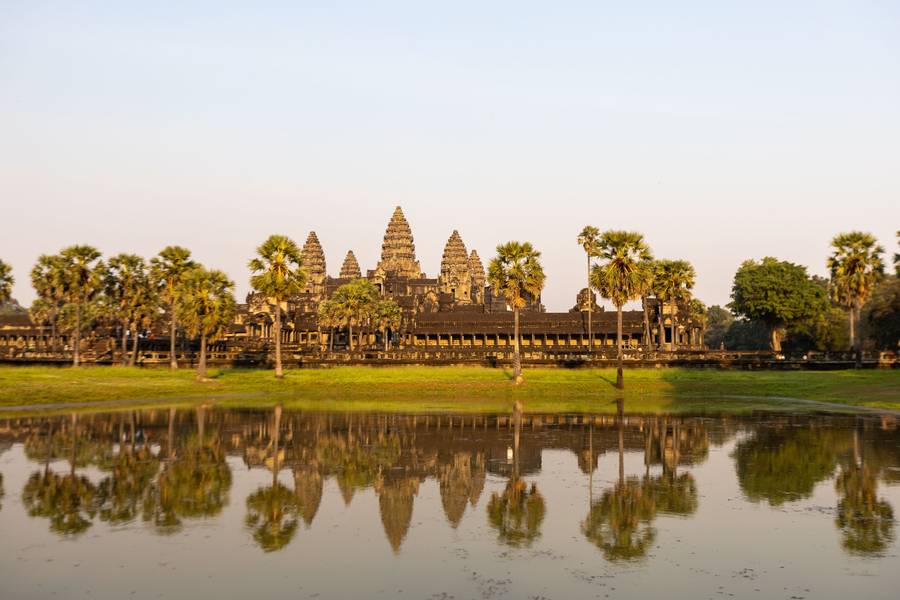
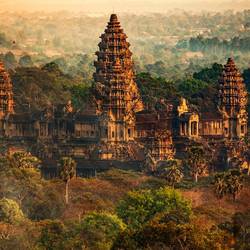
Angkor Wat is the world's largest religious monument and the defining image of Cambodia. Built in the first half of the 12th century by King Suryavarman II, the temple complex covers 162 hectares and was originally dedicated to the Hindu god Vishnu. Its five central towers, the tallest rising 65 metres, represent the five peaks of Mount Meru, the sacred mountain at the centre of the Hindu cosmos. The temple faces west — unusual for Khmer architecture — and this orientation is responsible for the extraordinary sunrise silhouette that photographers and early-rising visitors travel across the world to see.
Architecture and Bas-Reliefs
The inner gallery of Angkor Wat stretches 800 metres around the central sanctuary, covered almost entirely in carved bas-reliefs. These scenes depict episodes from Hindu mythology, including the churning of the cosmic ocean and the armies of King Suryavarman II on the march. The level of detail — individual figures no taller than a hand, yet each one expressive — is considered the pinnacle of Khmer artistic achievement. Spending time in the gallery before climbing to the upper terraces gives the architecture a narrative context that makes the ascent feel like the culmination of a long story.
Sunrise at the Reflecting Pool
The north-facing reflecting pool in front of the western causeway is one of Southeast Asia's great sunrise spots. The rising sun illuminates the towers from behind at dawn, casting long reflections across the still water that shift in colour as the light strengthens from deep blue to pink to gold. Arriving by 5:00 AM gives you time to find a position before the light peaks; the ticket office opens at 4:30 AM to accommodate early visitors. The walk from the main gate to the pool takes about ten minutes along a broad stone causeway lined with boundary stones and guardian figures.
Entry and Opening Hours
An official Angkor Pass is required for entry and covers the entire Angkor Archaeological Park. A one-day pass costs USD 37, a three-day pass costs USD 62, and a seven-day pass costs USD 72. Children under 12 enter free with a paying adult. The complex is open daily from 5:00 AM to 6:00 PM, and passes must be purchased at the Angkor Enterprise Ticket Center on Road 60 or through the official Angkor Enterprise website.
Planning your flights to Siem Reap early gives you the widest choice of departure times — arriving on an evening flight means you can be at the temple gates for sunrise the very next morning.
Discover Flights With Traveloka
Sun, 25 Oct 2026

AirAsia Cambodia
Kuala Lumpur (KUL) to Siem Reap (SAI)
Start from RM 315.87
Fri, 9 Oct 2026

Thai AirAsia
Bangkok (DMK) to Siem Reap (SAI)
Start from RM 381.12
Mon, 28 Sep 2026

Vietnam Airlines
Singapore (SIN) to Siem Reap (SAI)
Start from RM 655.06
2. Bayon Temple
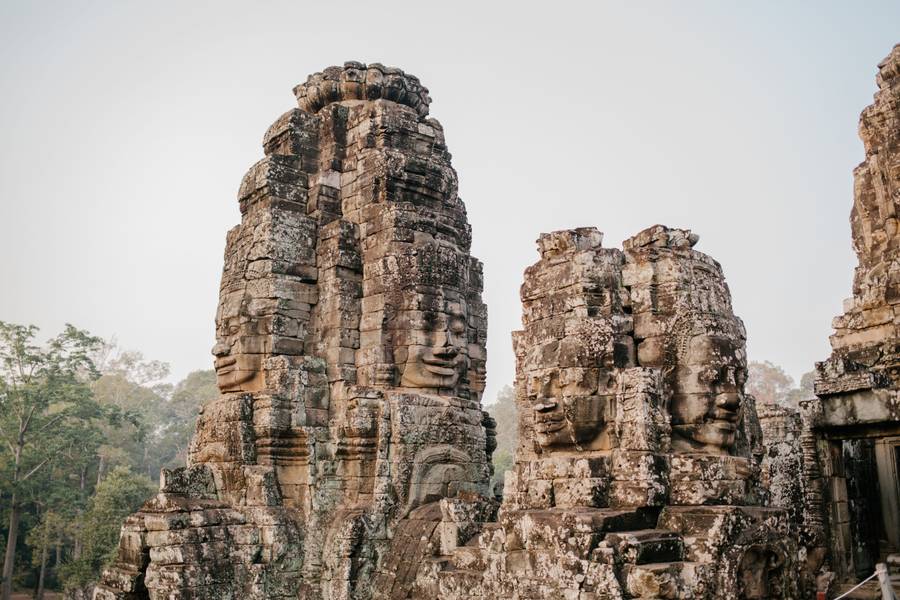
Bayon is the state temple of Angkor Thom, the last great capital of the Khmer Empire, and one of the most visually striking monuments in all of Southeast Asia. Built in the late 12th to early 13th century by King Jayavarman VII, the temple is instantly recognisable for the 216 serene stone faces carved across its 54 towers. The faces are widely believed to represent the Bodhisattva Avalokiteshvara, although some scholars interpret them as idealised portraits of Jayavarman VII himself, projecting his power across every direction of the compass.
Standing at the upper terrace of Bayon, surrounded by towers on every side, each face gazing in a different direction, is an experience unlike anything else in the Angkor complex. The bas-reliefs on the lower galleries depict scenes from daily Khmer life as well as military campaigns against the Cham people of present-day Vietnam, providing a vivid historical record that complements the more mythological imagery at Angkor Wat. Bayon is situated at the centre of Angkor Thom, a walled city approximately three kilometres square, and it is typically combined with Angkor Wat in a full-day temple circuit. Plan to arrive early in the morning when the sandstone turns golden in the low angled light and the site is at its quietest.
3. Ta Prohm
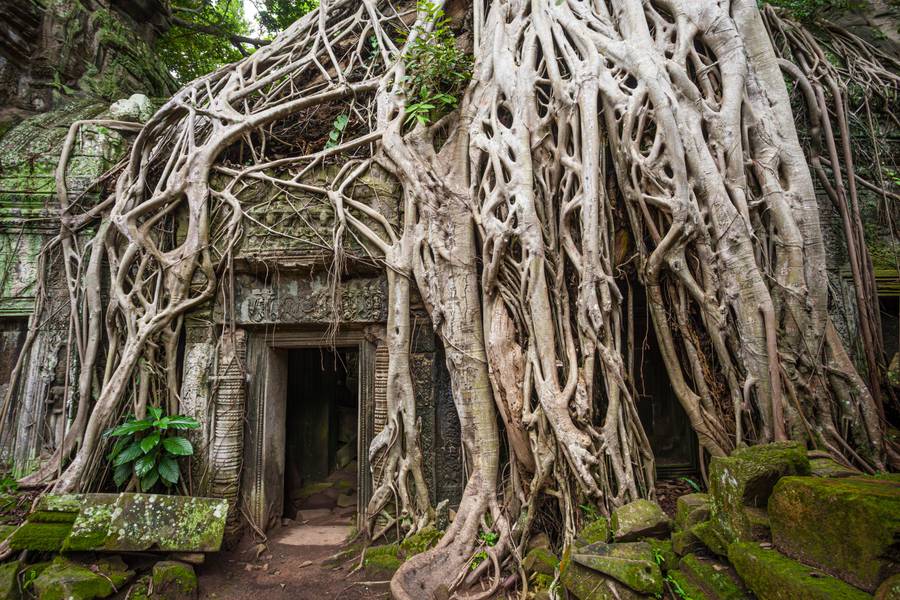
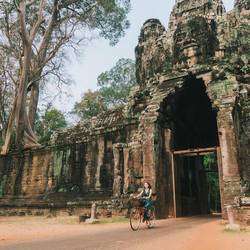
Ta Prohm is the temple that nature has reclaimed. Enormous silk-cotton and strangler fig trees have forced their roots through the stone walls, vaults, and galleries, splitting blocks that weigh several tonnes as casually as cracking a nut. The temple was built in the late 12th century by King Jayavarman VII and dedicated to his mother; at its height, the complex housed more than 12,500 people including priests, dancers, scholars, and administrative staff. The scale of what stands today is only a fraction of what once existed.
Unlike most Angkor temples, which have been cleared and partially restored, Ta Prohm was deliberately left in a semi-ruined, forest-covered state to preserve its atmospheric quality. Moving through its dim, root-wrapped corridors and vine-draped galleries is something no photograph fully captures — the humidity, the filtered green light, and the scale of the trees pressing against the stone walls create an immersive quality that is unique within the Angkor complex. Ta Prohm is included in the standard Angkor Pass and sits within an easy tuk-tuk ride of the main Angkor Wat compound.
4. Banteay Srei
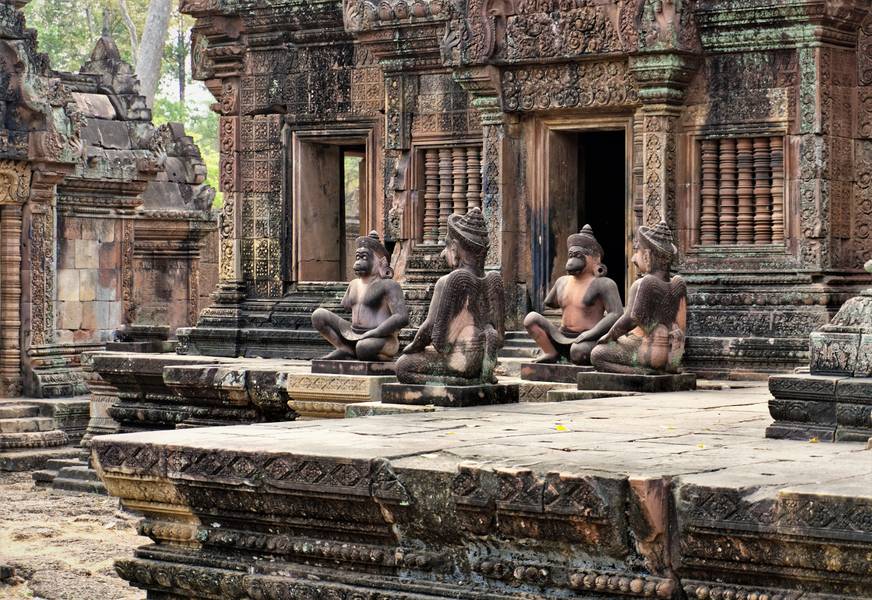
Banteay Srei is considered the finest example of classical Khmer art. Built in the 10th century and dedicated to the Hindu gods Shiva and Vishnu, the temple is unusually small in scale, but every surface is covered in carvings of extraordinary intricacy and precision. The deep-relief decorations of floral scrolls, celestial apsara dancers, and scenes from the Hindu epics Mahabharata and Ramayana are so finely executed that art historians have long described Banteay Srei as the "jewel of Khmer art." The name itself translates roughly as "citadel of women," a reference to the delicate, feminine quality of the carvings.
The temple is built from pink sandstone rather than the grey sandstone used at Angkor Wat, which gives it a warm, rose-coloured appearance that deepens beautifully in the afternoon light. It sits about 25 kilometres north of the main Angkor complex, making it slightly further from Siem Reap town but easily reachable with advance planning. Entry is included in the Angkor Pass. Hiring a car rental or a private driver for the day is the most practical approach — the distance makes it awkward to combine with a standard half-day temple circuit using shared transport, and a driver can also stop at the Landmine Museum and Banteay Samre temple on the way back.
Siem Reap offers some of Southeast Asia's best-value accommodation, from boutique guesthouses near the old market to riverside resorts just minutes from the temple gates — book your hotels early to secure the best locations and rates.
5. Preah Vihear
Preah Vihear is one of the most dramatically situated temples in Southeast Asia. Perched on a cliff in the Dangrek Mountains at an elevation of approximately 525 metres, the temple overlooks a vast expanse of Cambodian lowland that stretches to the horizon on a clear day. It was built primarily during the reigns of Kings Suryavarman I and Suryavarman II in the first half of the 11th century and dedicated to the Hindu god Shiva. UNESCO inscribed Preah Vihear as a World Heritage Site in 2008 in recognition of its outstanding architectural and cultural significance.
Architecture and Processional Route
The temple is arranged along an 800-metre axial processional route that climbs the cliff in a series of linked sanctuaries, gopura gateways, and ceremonial staircases. Each gateway is more ornate than the last, creating a sense of ritual ascent towards the main sanctuary at the summit. The carved lintels and pediments at each level depict scenes from Hindu mythology, with the quality of carving increasing as you climb higher towards the inner sanctuary. The location serves simultaneously as a spectacular viewpoint and as a physical expression of the temple's dedication to the gods of the mountain.
Getting There
Preah Vihear sits in a remote part of northern Cambodia, accessible from Siem Reap via a road journey of approximately five to six hours. The site is best suited to travellers who have already spent two or three days exploring the main Angkor temples and want to venture beyond the established tourist circuit. The journey offers its own rewards, passing through rice-farming landscapes and small provincial towns that give a sense of rural Cambodian life far from the major cities.
6. Sambor Prei Kuk
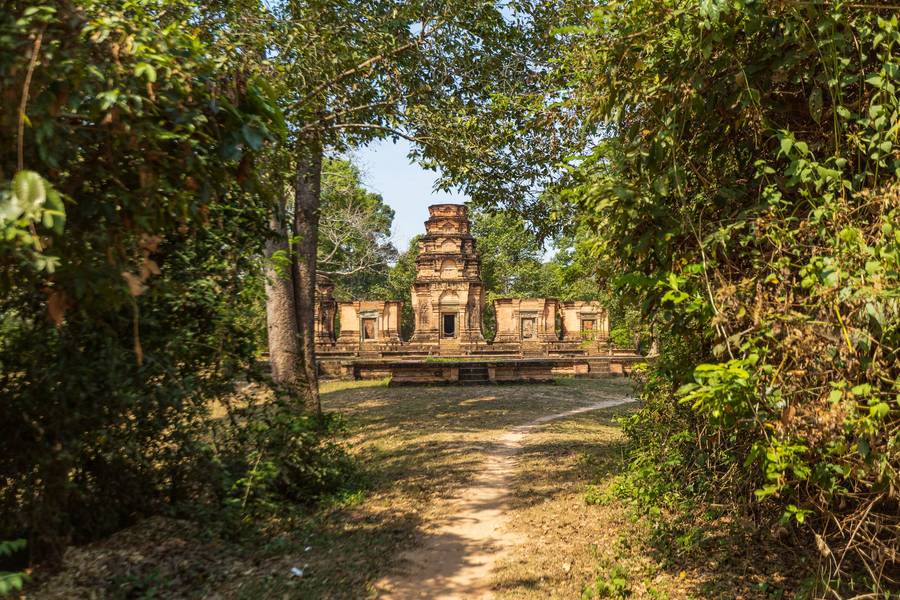
Sambor Prei Kuk is Cambodia's oldest major archaeological site and the country's only pre-Angkorian complex to achieve UNESCO World Heritage status, inscribed in 2017. Located in Kampong Thom Province, roughly two hours by road from Siem Reap, the site dates to the 7th century and represents the earliest phase of Khmer temple-building — three centuries before the great monuments of Angkor. Over 100 individual temples are scattered across the forested site, arranged in three main groups, each originally enclosed by its own moat and earthen walls.
The temples at Sambor Prei Kuk display a distinctive circular tower design and a decorative style that predates the classic Angkorian vocabulary. Carved round towers, intricate lintels, and stone panels depicting Hindu deities demonstrate the sophistication of the Chenla Kingdom, which ruled much of mainland Southeast Asia before the rise of the Angkor Empire. Because the site sees far fewer visitors than the temples of Siem Reap, it offers a quieter, more contemplative experience of Cambodia's ancient heritage, with sections of forest-covered ruins that have a raw, exploratory quality entirely different from the manicured walkways of Angkor Wat. The site is open daily and entry is payable at the gate.
From guided temple tours at sunrise to apsara dinner shows and tuk-tuk circuits through the Angkor complex, Siem Reap has a rich range of activities worth booking before you arrive — secure your spot on the most popular experiences early.
7. The Silver Pagoda and Royal Palace, Phnom Penh
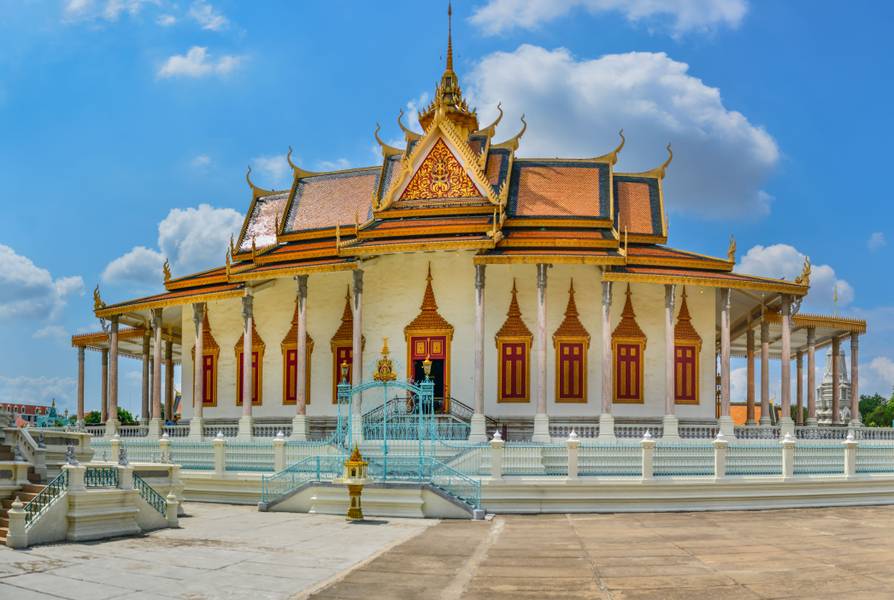
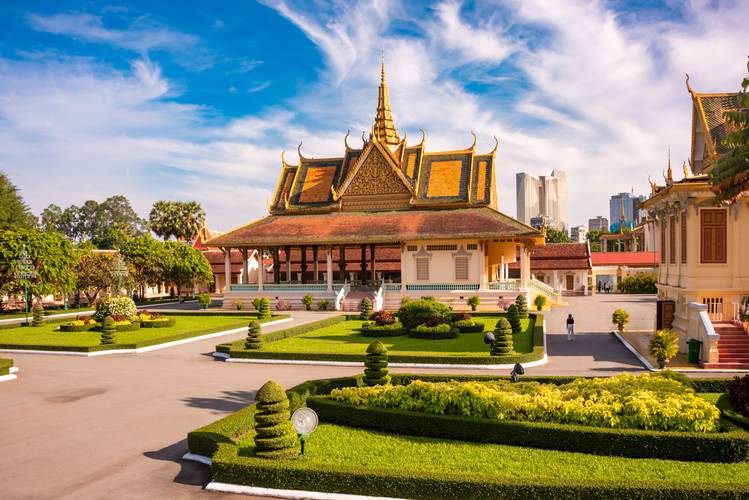
Cambodia's capital holds two of the country's most significant historical landmarks within a single walled compound on the banks of the Tonle Sap River. The Royal Palace was constructed from 1866 under King Norodom and has served as the official residence of the Cambodian monarch ever since; several of its buildings are open to visitors and offer a clear sense of the architectural style that blended Khmer and French colonial influences in the late 19th century. Adjacent to the palace, the Silver Pagoda takes its name from the 5,000 silver tiles that cover its floor, each weighing approximately one kilogram.
Inside the Silver Pagoda, the most revered object is the Emerald Buddha, a small figure believed to date from the 17th century. A life-sized golden Buddha studded with 9,584 diamonds stands nearby, and the pagoda's outer gallery walls are lined with a mural depicting scenes from the Reamker, the Cambodian adaptation of the Hindu Ramayana epic. The compound is one of the best-preserved sites in Phnom Penh and provides a concentrated introduction to Cambodian royal history and Buddhist art in a single visit. Arranging an airport transfer in advance makes arriving in Phnom Penh straightforward, as city traffic can be dense and navigating it with luggage adds unnecessary stress to the start of a trip.
Plan Your Trip with Southeast Asia's #1 Travel App
Planning a Cambodia itinerary across multiple historical sites is much simpler when your bookings are consolidated in one place. Traveloka, Southeast Asia's leading travel platform trusted by over 100 million users, lets you compare flights, browse hotels across Siem Reap and Phnom Penh, and book guided tours and cultural experiences — all within a single app. Whether you are looking for a boutique guesthouse two minutes from the old market or a resort with a view of the rice fields, the range of options covers every travel style and budget.
Watch for Traveloka promotions to find deals on flights and hotels for Cambodia travel. The Traveloka app also covers car rentals, eSIM data plans, and travel insurance, making it easy to handle every detail of your trip from one screen. Download the app — top-rated on the Google Play Store and Apple App Store across Southeast Asia — and start building your Cambodia itinerary today.

In This Article

Recommended Articles

7 Romantic Dining Restaurants in Penang for Couples
10 Best Tourist Attractions Near the Great Wall of China
Japan 7-Day Itinerary: Tokyo and Kyoto
Japan 14-Day Itinerary: Tokyo to Hiroshima in Two Weeks
Hangzhou to Shanghai: A Complete Transport and Travel Guide
Best Luxury Resorts in Da Nang for an Unforgettable Stay


