


Flights Manila to Bali
Search and book cheap flight tickets from Manila to Bali / Denpasar

Flight Information from Manila (MNL) to Bali / Denpasar (DPS)
Shortest flight duration
4 hr(s)
Manila to Bali Flight Schedule
Airline | Departure Time | Arrival Time | Origin airport | Destination airport | |
|---|---|---|---|---|---|
 Cebu Pacific | 19:50 | 00:00 (+1 day) | Manila (MNL) | Bali / Denpasar (DPS) | Book flight |
 Garuda Indonesia | 19:55 | 23:55 | Manila (MNL) | Bali / Denpasar (DPS) | Book flight |
 Philippine Airlines | 19:55 | 23:55 | Manila (MNL) | Bali / Denpasar (DPS) | Book flight |
Manila to Bali Fares Month by Month
Manila to Bali Flight FAQ
Manila-Bali flights take roughly 4 hours to 4 hours 10 minutes, covering about 2,660 kilometers — the longest regular Southeast Asian nonstop out of Manila. Every scheduled flight on this route is nonstop.
Philippine passport holders can enter Indonesia visa-free for stays of up to 30 days. The allowance is not extendable, and overstaying draws a daily fine, so plan your return date with some buffer.
Nyepi is Bali's Day of Silence, typically falling in March, when the entire island observes a 24-hour shutdown — no flights land or depart, and businesses close. A trip that straddles the date needs an extra buffer day built in.
No — Bali runs on Indonesia's WITA time zone, which matches Manila exactly, so there's no clock to adjust. Jakarta, on the other hand, sits an hour behind Bali.
Bali's dry season runs roughly April through October, and the July-August school-holiday stretch layers extra demand on top of that already-peak window, pushing fares up alongside the December holiday spike.
Yes, a recliner-style business seat on the Airbus A321 it flies this route with — there's no fully flat product on this pairing. Cebu Pacific flies the route as economy-only.
Flights from Manila to Bali
Why Manila to Bali Is Manila's Longest Regular Southeast Asian Hop
That thinner field reflects Bali's role as a leisure-specific destination rather than a business or connecting hub — almost nobody flies this route for a stopover onward, the way a share of Kuala Lumpur or Singapore traffic does, so demand here tracks Bali's own tourist season more directly than most of Manila's other international routes.
Flight Fares from Manila to Bali
Return fares on Traveloka start from ₱ 5,646.63. Cebu Pacific carries the larger share of seats on this route and is typically the lower fare of the two, while Philippine Airlines bundles a checked bag and meal into a higher base price.
How Prices Move Across the Year
Bali's dry season, roughly April through October, is when both flight and resort demand peak, with the July-August school-holiday stretch and the Christmas-to-New-Year period layering an extra spike on top of that already-elevated window. Galungan and Kuningan, Balinese Hindu holidays that recur every 210 days on the Balinese Pawukon calendar rather than a fixed Gregorian date, bring a smaller, more localized surge in domestic Indonesian travel that touches inbound fares less directly. The wetter months from November through March are the more genuinely negotiable stretch, outside of the December holiday spike itself.
Daily Departure Patterns
Cebu Pacific and Philippine Airlines don't both fly every single day, so checking actual availability on your travel dates before comparing fares is worth doing here more than on routes with daily service from every carrier.
Airlines Flying Manila to Bali
Cebu Pacific carries the larger share of this route's seats and is the lower-fare option of the two. Philippine Airlines is the full-service alternative, with baggage and a meal included in its base fare. No other airline currently flies this route nonstop — a noticeably thinner field than Manila's Southeast Asian routes with more transit-hub relevance.
Nonstop Flying Time
Flying Out of Manila
Ninoy Aquino International Airport (MNL)
Beyond that, this is an ordinary international departure with no further route-specific quirk.
Arriving in Bali
Ngurah Rai International Airport (DPS)
Ngurah Rai sits only about 13 kilometers south of Denpasar and just a few kilometers from Kuta, making it one of the closer major airport-to-resort-strip distances anywhere in Southeast Asia — a taxi to Kuta can take as little as 20 to 30 minutes depending on traffic, versus 30 to 45 minutes into central Denpasar itself. Domestic and international arrivals share the same connected terminal building, so there is no separate structure to navigate between if you're continuing on to another Indonesian island. Pre-paid taxi vouchers and the Trans Sarbagita public bus both run from the airport into Kuta, Legian, and Denpasar at a fraction of a metered taxi's cost.
Cabin Classes on This Route
Things to Do in Bali
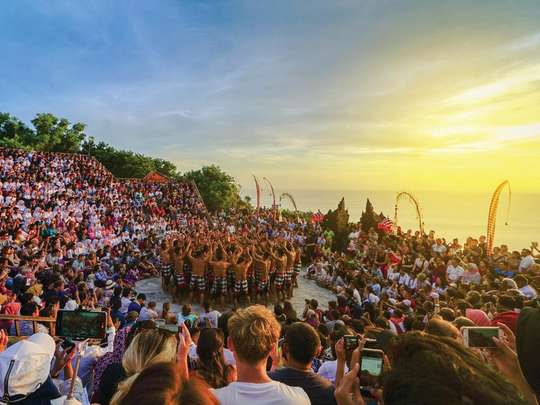
Uluwatu, on the island's southwestern cliffs, is best known for its sea-cliff temple, sunset views, and some of Bali's most consistent surf breaks, with lesser-known beaches like Padang-Padang and Bingin tucked into the coves below. Ubud, further inland, is Bali's cultural and artistic center, set among rice terraces and known for its traditional dance performances and art markets rather than beach time. Kuta and its neighboring Legian and Seminyak form the island's original tourist strip, dense with beach clubs, shopping, and nightlife within walking distance of each other. The Garuda Wisnu Kencana Cultural Park, home to a 120-meter bronze statue of the Hindu deity Vishnu riding the mythical bird Garuda, is one of the island's most visible modern landmarks, visible from parts of the airport approach itself. Tanah Lot, a sea temple built on a rock formation off the island's southwest coast, is one of Bali's most photographed sights at low tide, when visitors can walk out toward the temple itself, though the inner sanctum is reserved for worshippers rather than tourists.
Bali's Ceremonial Calendar
Nyepi, the Balinese Hindu New Year, is unlike any other holiday on Manila's international route network: the entire island observes a full 24-hour Day of Silence, typically falling in March, during which no flights land or depart, businesses close, and even the streets are meant to stay empty of traffic and, after dark, light. Anyone flying into or out of Bali needs to plan around Nyepi specifically — a trip that straddles the date will need to build in an extra day rather than assume travel is possible on the day itself. Galungan and Kuningan, recurring every 210 days on the Balinese Pawukon calendar, bring processions and temple offerings across the island without shutting anything down the way Nyepi does. Visitors already on the island when Nyepi falls are generally asked to stay within their hotel grounds for the day, with resorts typically arranging low-key in-house activities and meals in advance, so it isn't a day to plan an excursion around regardless of how the rest of your itinerary is shaped.
Where to Stay in Bali
Seminyak and Kuta offer the most walkable base for a first visit, close to the airport and dense with restaurants, beach clubs, and nightlife. Uluwatu suits travelers prioritizing surf and cliffside sunset views over walkable nightlife, at the cost of a longer drive back from most of the island's other sights. Ubud, an hour or more inland from the coast, is the choice for a slower, culture-and-rice-terrace-focused stay rather than a beach-based one. Canggu, north of Kuta, has grown into a mid-point option popular with longer-stay visitors, with a café and co-working scene distinct from either the older Kuta strip or Ubud's cultural focus.
Travel Tips for Manila-Bali Flights
Philippine passport holders can enter Indonesia visa-free for stays of up to 30 days, an allowance that is not extendable — overstaying draws a daily fine, so plan the return date with some buffer rather than cutting it exactly to 30 days. Indonesia uses its own currency, the rupiah, but Bali specifically keeps the same time as Manila under Indonesia's WITA zone, so there is nothing to adjust on arrival — a genuine rarity for a flight this long out of Manila. Jakarta, on the other hand, runs an hour behind Bali, worth knowing if your trip continues on to Indonesia's capital. Tap water isn't safe to drink in Bali, so budgeting for bottled or filtered water throughout the trip, including for brushing teeth, is worth planning for rather than assuming hotel-standard practices match Manila's.
Alternative Routes from Manila
If your Southeast Asia trip is flexible on destination rather than fixed on Bali specifically, Manila to Jakarta is a shorter, cheaper alternative into a different part of Indonesia entirely. Every other flight to Indonesia from the Philippines is listed on Traveloka's country page.
Why Book Manila to Bali on Traveloka
Easy Reschedule is there if your plans shift, and GCash or over-the-counter payment are accepted alongside the standard cards at checkout.
Manila to Bali Flight Facts
Flight Duration | 4 hr(s) 0 mins |
Airport in Manila | |
Airport in Bali / Denpasar |
For all your unique travel choices, we got you
Popular Routes from Ninoy Aquino International Airport
Popular Routes to Bali / Denpasar
Popular Airlines
Popular Nearby Airports
Countries in this Route
Flight Status on this Route

Popular Airline








Have your dream trip at your fingertips. Get The App.


