7 Best Historical Sites in Egypt: From the Pyramids of Giza to Abu Simbel


Egypt's historical landscape is unlike any other in the world. A civilisation that flourished for over 3,000 years along the banks of the Nile left behind monuments of such scale, ambition, and longevity that they remain extraordinary even by modern standards — colossal stone temples, royal tombs hidden in desert valleys, and pyramids that were already ancient when Julius Caesar visited. The majority of Egypt's greatest historical sites are clustered along the Nile between Cairo in the north and Aswan in the south, a travel corridor that can be covered by flight, train, or the traditional Nile cruise.
This guide covers seven of Egypt's most iconic ancient sites, with practical details on entry fees, visitor tips, and the best way to reach each one. Note that nearly all major archaeological sites in Egypt now accept card payments only — carrying a credit or debit card is essential.
1. The Pyramids of Giza and the Great Sphinx

The Pyramids of Giza are the only surviving members of the Seven Wonders of the Ancient World and among the most recognisable structures ever built. The Giza complex, located on a plateau on the western outskirts of Cairo, contains three major pyramids — the Great Pyramid of Khufu, the Pyramid of Khafre, and the smaller Pyramid of Menkaure — along with their associated valley temples, causeways, and subsidiary tombs. The pyramids were constructed during the Fourth Dynasty of the Old Kingdom, approximately between 2575 and 2465 BC, and represent the most ambitious building project of the ancient world.
The Great Pyramid of Khufu
The Great Pyramid, built for Pharaoh Khufu around 2560 BC, originally stood 146.5 metres tall and was the tallest man-made structure in the world for over 3,800 years. It contains approximately 2.3 million stone blocks, each weighing an average of between 2.5 and 15 tonnes, and its four faces are aligned to the cardinal points of the compass with an accuracy of less than one-tenth of one degree. The interior includes three chambers — the subterranean chamber, the Queen's Chamber, and the King's Chamber — connected by ascending passages; entry to the interior requires a separate ticket in addition to general site admission. Ongoing research using muon tomography has revealed previously unknown voids within the pyramid that have not yet been entered or fully mapped.
The Great Sphinx
The Great Sphinx is a limestone monolith carved from the natural bedrock of the Giza plateau, depicting a recumbent lion with a human head widely identified as Pharaoh Khafre. At 73 metres long and 20 metres high, it is the largest monolith sculpture in the world. The Sphinx faces east towards the rising sun and is positioned at the entrance to the causeway leading to Khafre's pyramid complex, placing it at the ritual threshold of the royal funerary landscape. The nose, now absent, was reportedly removed sometime in the medieval period — historical accounts vary on exactly when and by whom.
Tickets and Practical Information
Entry to the Giza Plateau costs 600 EGP for international visitors; separate tickets are required for entry to the interior of the Great Pyramid and Khafre's Pyramid, each sold in limited daily numbers. All payments are by card only. Arranging an airport transfer from Cairo International Airport to the Giza area takes approximately 45 to 60 minutes by private vehicle depending on traffic, and booking in advance ensures a stress-free arrival before an early-morning visit to the plateau.
Cairo is Egypt's primary international gateway, with direct connections from across the Middle East, Europe, and Asia. Compare flights to Cairo International Airport to find the best-priced options for your travel dates.
Discover Flights With Traveloka
Thu, 1 Oct 2026

AirAsia Indonesia
Jakarta (CGK) to Cairo (CAI)
Start from Rp 6.206.500
Sun, 27 Sep 2026

Flyadeal
Jeddah (JED) to Cairo (CAI)
Start from Rp 706.400
Sun, 4 Oct 2026

Gulf Air
Kuala Lumpur (KUL) to Cairo (CAI)
Start from Rp 4.626.482
2. The Grand Egyptian Museum, Cairo

The Grand Egyptian Museum is the largest archaeological museum in the world and the permanent home of the most complete collection of ancient Egyptian artefacts ever assembled under a single roof. Located near the Pyramids of Giza, the museum opened its permanent galleries in 2024 after more than two decades of construction and covers approximately 90,000 square metres of exhibition space. The centrepiece of the collection is the complete treasure of Tutankhamun — all 5,000 objects discovered in his tomb by Howard Carter in 1922, including the golden death mask, the throne, and the ceremonial chariots — displayed together in their entirety for the first time since the original discovery.
The Grand Staircase, rising five storeys through the museum's soaring atrium, is lined with colossal royal statues transported from sites across Egypt, and the permanent galleries extend across themed exhibition halls covering every major period of ancient Egyptian history from the Predynastic era to the Roman period. The museum also holds the two colossal statues of Ramesses II that once flanked the entrance of the old Egyptian Museum in downtown Cairo, reinstalled at the new building's entrance at a scale that finally matches their original context. Entry costs 1,450 EGP for international visitors; student tickets are available at a 50% reduction with a valid international student ID. All payments are by card only.
3. Karnak Temple Complex, Luxor
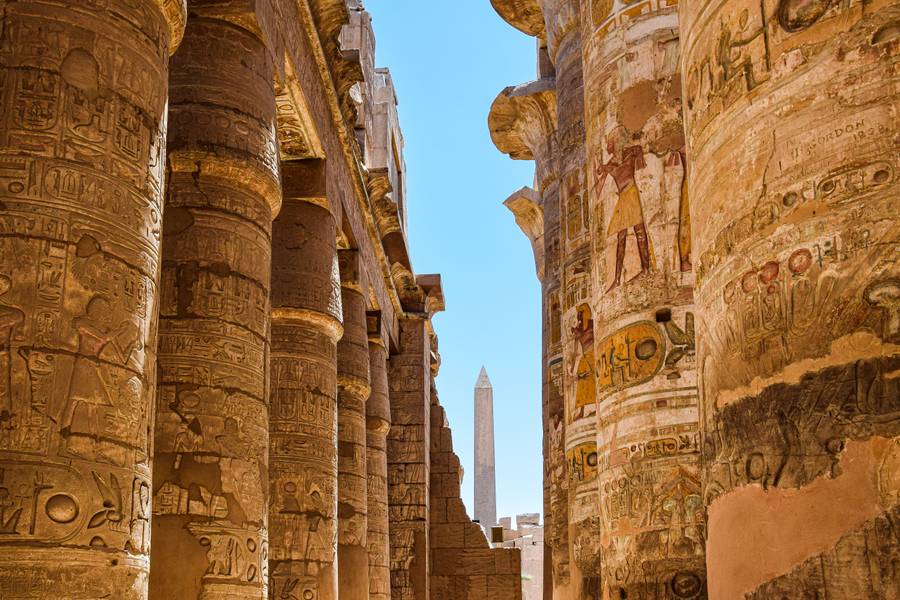
Karnak is the largest religious building complex ever constructed and the result of nearly 2,000 years of continuous building by the pharaohs of ancient Egypt. Located on the east bank of the Nile at Luxor, 700 kilometres south of Cairo, the complex covers approximately 250 acres and includes temples, pylons, sanctuaries, and obelisks built and expanded by successive dynasties from the Middle Kingdom through the Ptolemaic period. The site is effectively a record of Egyptian architecture across most of its dynastic history, with each pharaoh adding to, modifying, or embellishing the work of predecessors in a competition of monumental generosity to the gods. The main complex is dedicated to the god Amun-Ra.
The Great Hypostyle Hall is the centrepiece of Karnak and one of the most breathtaking architectural spaces of the ancient world. It contains 134 sandstone columns arranged in 16 rows, the central 12 rising to 21 metres in height and decorated from base to capital with carved and painted reliefs; the entire hall covers 5,000 square metres. Entry to the Karnak Temple Complex costs 200 EGP; all payments are by card. The Avenue of Sphinxes, recently restored and reopened, runs 2.7 kilometres from Karnak's southern gate to Luxor Temple at the edge of the city — following this processional route on foot is one of the most immersive experiences ancient Egypt has to offer.
4. The Valley of the Kings, Luxor

The Valley of the Kings is the necropolis of the pharaohs of the New Kingdom, a remote wadi on the West Bank of the Nile opposite Luxor where 63 tombs have been discovered to date. The pharaohs of the 18th, 19th, and 20th Dynasties — including Tutankhamun, Ramesses II, Seti I, and Hatshepsut — were buried here in tombs cut deep into the limestone cliffs, each decorated with elaborate paintings and hieroglyphic texts from the Book of the Dead intended to guide the deceased through the underworld. The valley was used as a royal burial ground for approximately 500 years, from around 1550 to 1069 BC, and new tombs continue to be discovered — the most recent significant find, KV64, was located in 2011.
The entry fee of 240 EGP includes access to three tombs selected from those currently open; the tomb of Tutankhamun (KV62) and the large twin tomb of Ramesses V and VI (KV9) require separate supplementary tickets purchased at the site. All payments are by card. Arriving at opening time — the valley opens at 6:00 AM — allows you to move through the more popular tombs before the heat builds and coach tours arrive. Hiring a car rental or a private driver for the day is the most practical way to combine the valley with the nearby Mortuary Temple of Hatshepsut and the Colossi of Memnon on the West Bank.
Cairo offers the widest choice of accommodation for Egypt travel, from historic riverside properties to well-priced city-centre hotels near the Grand Egyptian Museum — browse hotels in Cairo to find the right base for your Nile Valley itinerary.
5. Luxor Temple

Luxor Temple is one of the best-preserved ancient Egyptian temples and one of the most rewarding to visit in the evening, when floodlighting transforms the sandstone columns and entrance pylons into a dramatic interplay of light and shadow against the night sky. Built primarily by Pharaoh Amenhotep III in the 14th century BC and later expanded by Ramesses II, who added the monumental entrance pylon, two seated colossi, and a pair of obelisks — one of which now stands in the Place de la Concorde in Paris — the temple has a coherent, unified architectural quality that makes it unusually legible compared to the layered complexity of Karnak. The temple was dedicated to the Opet Festival, an annual celebration of the divine union between Amun-Ra and his consort Mut.
Entry to Luxor Temple costs 250 EGP; all payments are by card. The temple is open daily and sits on the east bank of the Nile in the centre of Luxor town, walkable from most hotels in the city. The southern end of the Avenue of Sphinxes, the 2.7-kilometre processional road reopened to the public in 2021 after decades of restoration, begins here and connects directly to the northern entrance of Karnak, making it possible to walk the entire ancient ceremonial route between the two great temples in a single morning.
6. The Temple of Philae, Aswan

The Temple of Philae is one of the most romantically situated ancient sites in Egypt — a complex of late Ptolemaic and early Roman temples dedicated to the goddess Isis, set on an island in the Nile above the First Cataract near Aswan. The original temples were built between 380 BC and 362 AD, making the complex one of the last temples built in the traditional ancient Egyptian style and one of the last active centres of the ancient Egyptian religion, with the worship of Isis continuing here until the reign of the Emperor Justinian in the 6th century AD. When the construction of the Aswan High Dam threatened to permanently submerge the island, UNESCO coordinated one of the largest cultural salvage operations in history, dismantling and relocating the entire temple complex to the higher ground of nearby Agilkia Island between 1977 and 1980.
The setting of the reassembled temples, surrounded by water on all sides with granite boulders and the sounds of the Nile nearby, retains the island atmosphere of the original site. The Temple of Isis, with its columned courtyard and carved reliefs depicting ritual scenes between pharaohs and gods, is among the most complete surviving examples of Ptolemaic temple architecture. The site is accessible only by boat from the nearby Shellal quay, and entry tickets are purchased at the quay before boarding. Booking your activities in Egypt in advance — from half-day Giza tours to combined Karnak and Luxor Temple excursions — secures your spot with an English-speaking guide and simplifies every day of your itinerary.
7. Abu Simbel, Aswan Governorate

Abu Simbel is one of the most awe-inspiring monuments of the ancient world — two massive rock-cut temples carved into a sandstone cliff on the west bank of Lake Nasser in southern Egypt, approximately 280 kilometres south of Aswan. The temples were built by Pharaoh Ramesses II between approximately 1264 and 1244 BC to celebrate his military victories and to project Egyptian power deep into Nubia. The entrance to the larger temple is flanked by four colossal seated statues of Ramesses, each standing 20 metres tall, carved directly from the living rock. The smaller temple is dedicated to Ramesses' queen, Nefertari, and the goddess Hathor — one of the rare instances in ancient Egypt of a temple built in honour of a living queen.
Like Philae, Abu Simbel was rescued from rising floodwaters through a UNESCO-led salvage operation between 1964 and 1968, during which both temples were cut into 20-tonne blocks, moved 65 metres higher and 200 metres back from the original shoreline, and reassembled with precision so exact that the solar alignment was preserved: twice a year, on 22 February and 22 October, sunlight penetrates the full length of the inner sanctuary to illuminate three of the four seated deities inside. Entry to the Abu Simbel complex costs approximately 800 EGP for international visitors; all payments are by card. The site is most commonly visited as a day trip from Aswan by air — the flight takes 45 minutes — or by road convoy through the open desert, which takes approximately three hours each way.
Plan Your Trip with Southeast Asia's #1 Travel App
Egypt's historical sites span more than 1,000 kilometres of the Nile Valley, and planning a multi-destination itinerary across Cairo, Luxor, and Aswan is far more manageable when all your bookings are in one place. Traveloka, Southeast Asia's leading travel platform trusted by over 100 million users, covers international flights into Cairo, domestic flights between Cairo, Luxor, and Aswan, hotels along the Nile from budget guesthouses to five-star riverfront properties, guided tours of the Pyramids and the Karnak complex, car rentals for the West Bank temples, eSIM data plans for connectivity throughout Egypt, and travel insurance — all within a single app.
Watch for Traveloka promotions for deals on flights and hotels for Egypt travel. Download the Traveloka app — top-rated on the Google Play Store and Apple App Store across Southeast Asia — to start building your Egypt itinerary today.
In This Article


Recommended Articles

Dubai in Summer 2026: What the Weather Is Really Like and How to Make the Most of It

Paris in Winter: Your Complete Weather and Travel Guide for 2026

Paris in Spring: What the Weather Really Feels Like (And Why It's Worth It)

Seoul in Autumn: Your Complete Guide to the City's Most Spectacular Season

London Summer Guide: Weather, Festivals, and the Best Things to Do in June, July & August
Osaka in Spring: Cherry Blossoms, Warm Walks, and Perfect Weather for Exploring