7 Best Historical Sites in Japan: From Kyoto's Temples to Nikko's Shrines


Japan's historical legacy is written in wooden temples, stone gardens, lacquered shrines, and mountain castles that have endured for centuries across an archipelago shaped by imperial tradition, feudal culture, and deep spiritual practice. From the ancient capital of Kyoto, where dozens of UNESCO World Heritage Sites are packed within a single city, to the sacred deer parks of Nara, the white-walled keeps of Himeji, and the forested shrine complexes of Nikko, Japan offers a historical depth that rewards any length of visit. The country combines immaculate preservation with extraordinary accessibility, and most of its greatest historical sites are reachable by train within a few hours of each other.
This guide covers seven of Japan's most significant historical sites, each representing a distinct chapter in over 1,400 years of documented history — with confirmed entry fees, opening hours, and practical travel tips for each one.
1. Kinkaku-ji (The Golden Pavilion), Kyoto

Kinkaku-ji, the Temple of the Golden Pavilion, is the most photographed landmark in Japan and one of the most architecturally distinctive buildings in the world. The three-storey pavilion, covered on its upper two floors in pure gold leaf, stands at the edge of a still pond in Kyoto's northwestern hills, its reflection creating a symmetry that has inspired painters and visitors for over six centuries. The structure was built in 1397 as a retirement villa for the shogun Ashikaga Yoshimitsu and converted into a Zen Buddhist temple after his death. UNESCO designated Kinkaku-ji as part of the Historic Monuments of Ancient Kyoto in 1994; the current building dates from 1955, when the original was reconstructed after being destroyed by fire.
Three Floors, Three Architectural Styles
Each floor of Kinkaku-ji is built in a different historical Japanese architectural style, stacked in deliberate sequence. The ground floor, which is not covered in gold, follows the Shinden-zukuri style of Heian-period aristocratic residences. The second floor uses the Buke-zukuri style associated with the samurai class of the Muromachi period. The top floor is built in the Chinese Zen Karayo style, its exterior entirely sheathed in gold leaf. This layering of three distinct architectural traditions in a single structure was a statement of the shogun's mastery over every aspect of Japanese culture.
The Garden and Surrounding Grounds
The garden surrounding Kinkaku-ji is a classic example of Muromachi-period design, centred on the Kyokochi pond — Mirror Pond — whose still surface reflects the pavilion and the surrounding trees in every season. The garden path continues through cedar and maple woodland, past smaller subsidiary shrines and tea houses, to the exit gate. The path takes 20 to 30 minutes to walk at a relaxed pace and remains beautiful year-round, with the surrounding foliage turning vivid red and orange in November. Early morning visits offer the most peaceful atmosphere and the best light on the golden exterior.
Entry and Visiting Information
Entry to Kinkaku-ji costs ¥500 for general visitors. The temple is open daily from 9:00 AM to 5:00 PM, including national holidays. Kinkaku-ji is accessible by bus from Kyoto Station in approximately 40 minutes and is one of the busiest sites in the city, so arriving early on a weekday significantly reduces crowds. Arranging an airport transfer from Kansai International Airport directly to Kyoto on arrival is a smooth way to begin the trip — the journey takes approximately 75 minutes by express train or private transfer.
Kansai International Airport connects Kyoto and Osaka to destinations across Asia and beyond. Compare flights to find the best-priced options for your travel dates — booking early gives access to wider fare choices and preferred departure times.
Discover flight with Traveloka
Wed, 26 Aug 2026

VietJet Air
Jakarta (CGK) to Osaka (ITM)
Start from Rp 3.620.900
Fri, 28 Aug 2026

All Nippon Airways
Tokyo (HND) to Osaka (ITM)
Start from Rp 1.182.474
Thu, 20 Aug 2026
All Nippon Airways
Sapporo (CTS) to Osaka (ITM)
Start from Rp 1.360.694
2. Fushimi Inari Taisha, Kyoto

Fushimi Inari Taisha is one of Japan's most atmospheric Shinto shrines and the head shrine of Inari, the deity of rice, agriculture, foxes, and prosperity. The complex sits at the base of Mount Inari in southern Kyoto and is famous above all for its procession of approximately 10,000 vermillion torii gates, donated by individuals and businesses over the centuries, which now cover the mountain's network of trails in an almost continuous tunnel of orange-red extending over four kilometres to the summit and back. The shrine has been an important site of worship since at least 711 AD. Entry to the shrine grounds is free, and the complex is open 24 hours a day.
The main torii tunnel begins just behind the principal shrine buildings and immediately creates one of the most visually distinctive environments in Japan. The full round trip to the summit of Mount Inari takes two to three hours on foot, passing through dozens of smaller sub-shrines, stone fox figures serving as messengers of Inari, and views over the Kyoto basin through gaps in the forest canopy. The lower sections are busy throughout the day; the paths higher on the mountain are quieter and offer a more contemplative experience. Arriving at dawn is particularly rewarding — the low light angles through the gate tunnels in a way that photographs rarely fully capture.
3. Kiyomizudera, Kyoto

Kiyomizudera — the Temple of Pure Water — is one of the most celebrated Buddhist temples in Japan and the oldest temple in Kyoto, founded according to tradition in 778 AD. Situated on the forested hillside of Mount Otowa in the east of the city, the temple is best known for its main hall, which is built on a platform of 139 wooden pillars extending out over the hillside without a single nail, its broad veranda commanding sweeping views across Kyoto's pagoda rooftops toward the Higashiyama mountains. UNESCO designated Kiyomizudera as part of the Historic Monuments of Ancient Kyoto in 1994.
Below the main hall, the Otowa waterfall — from which the temple takes its name — flows into three separate channels, each associated with a different blessing: longevity, success in studies, and fortunate love. Visitors traditionally drink from one channel using a long-handled cup; the stone-paved approach lanes through the Higashiyama historic district, lined with ceramic shops, tea houses, and confectionery stalls, form one of the most enjoyable walks in Kyoto in any season. Entry to the main precinct costs ¥400. The temple opens from approximately 6:00 AM, making it an excellent first visit on an early morning before the city wakes.
4. Todai-ji Temple and Nara Park

Todai-ji is the largest wooden building in the world and home to Japan's largest bronze Buddha. The Great Buddha Hall (Daibutsuden), originally built in 752 AD under the patronage of Emperor Shomu and reconstructed in its current form in 1709, houses the Daibutsu — the Vairocana Buddha — which stands 15 metres tall and required over a decade of casting. UNESCO inscribed Todai-ji as part of the Historic Monuments of Ancient Nara in 1998. Nara is approximately 45 minutes from Kyoto by express train, making it an easy and rewarding day trip from the old capital.
Todai-ji stands within Nara Park, a 660-hectare public park where over 1,000 freely roaming sika deer have lived for centuries and are considered sacred messengers of the gods. The combination of a colossal eighth-century temple, wild deer grazing among the shrine buildings, and ancient stone lanterns lining the approach paths makes Nara one of the most atmospheric destinations in Japan. Entry to the Great Buddha Hall costs ¥600 for adults; the surrounding park and approach paths are free. Sika deer crackers, sold throughout the park, are the traditional way to interact with the animals.
Kyoto offers some of Japan's finest accommodation, from sleek city hotels near Kyoto Station to traditional ryokan inns in the Higashiyama historic district. Browse hotels in Kyoto to find the right base for your Japan itinerary.
5. Himeji Castle

Himeji Castle is the finest surviving example of Japanese feudal castle architecture and the country's most iconic keep. Standing 92 metres above the surrounding plain in Himeji city, the castle complex of 83 buildings was completed in its current form in 1609 and has survived intact through earthquakes, fires, and the Second World War. The brilliant white plaster exterior, which gives the castle its popular name Shirasagi-jo — the White Heron Castle — was applied to resist both fire and moisture. UNESCO inscribed Himeji Castle as a World Heritage Site in 1993.
The keep rises through six floors and a basement, each level progressively narrower, connected by steep internal ladders designed to slow any attacker who breached the outer defences. The views from the uppermost floor extend across Himeji city and the Harima Plain on clear days. Entry costs ¥2,500 for adults from 2026, with children under 18 admitted free. The castle opens daily at 9:00 AM with last entry at 4:00 PM. Himeji sits approximately 50 minutes west of Osaka and 30 minutes east of Hiroshima by shinkansen, making it a natural stop between the two cities. A car rental is most useful when combining Himeji with nearby attractions across Hyogo Prefecture, including the preserved castle town of Takeda and the Arima Onsen hot spring district.
6. Hiroshima Peace Memorial Park
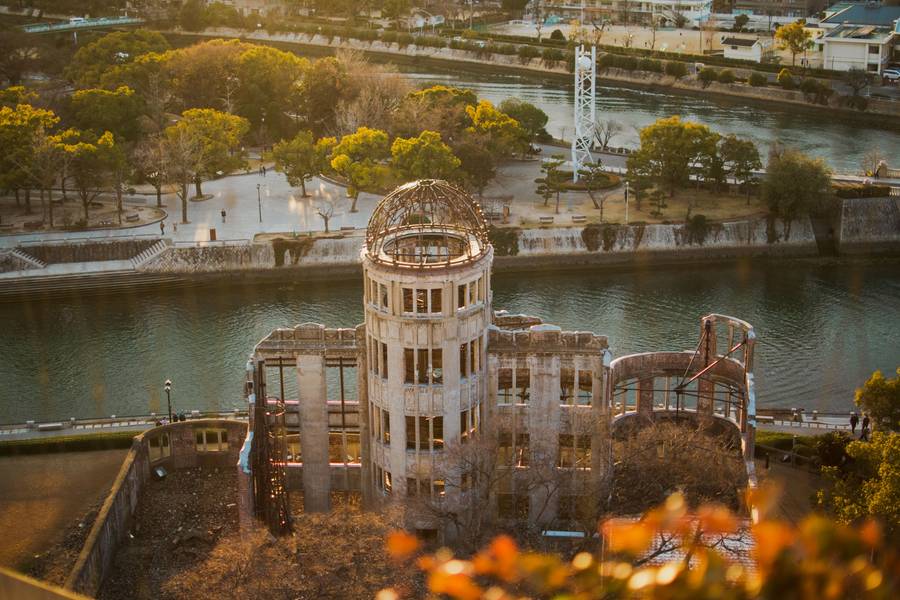
Hiroshima Peace Memorial Park stands at the centre of a city rebuilt from the ground up in the decades after the world's first atomic bomb was detonated there on 6 August 1945, and today it is one of the world's most powerful sites of peaceful remembrance. At its heart stands the Atomic Bomb Dome (Genbaku Dome), the skeletal iron frame of the former Hiroshima Prefectural Industrial Promotion Hall — the only structure near the hypocentre to remain standing. It was preserved as a permanent memorial and a symbol of the universal hope for peace; UNESCO inscribed it as a World Heritage Site in 1996, the first property inscribed specifically in connection with the events of the Second World War.
The Peace Memorial Museum traces the history and aftermath of the bombing through personal testimonies, artefacts, and photographs that make the experience among the most profound in Japan. Entry to the museum costs ¥200 for adults; the park and the Dome are free to visit. The Peace Flame at the centre of the park has burned continuously since 1964 and is intended to remain lit until the last nuclear weapon on Earth has been destroyed. Hiroshima is reached from Kyoto in approximately 1 hour 40 minutes by shinkansen.
From full-day Kyoto and Nara temple circuits to traditional yuzen craft workshops in the historic weaving districts, Japan's heritage activities book up quickly — securing your spots in advance makes a significant difference to the quality of your experience.
7. Nikko Toshogu Shrine

Nikko Toshogu is the most ornate Shinto shrine in Japan — a complex of 55 buildings in the mountains of Tochigi Prefecture, north of Tokyo, built in the early 17th century as the mausoleum of Tokugawa Ieyasu, the founder of the Edo shogunate who unified Japan after a century of civil war. Where most Japanese sacred architecture values restraint and natural materials, Toshogu is an almost overwhelming display of colour, carving, and lacquered decoration, with every major surface covered in painted reliefs, gilded fittings, and intricate woodwork depicting animals, birds, and mythological scenes. UNESCO inscribed the Shrines and Temples of Nikko as a World Heritage Site in 1999.
The approach to the shrine leads through a cedar forest planted in the early 17th century — trees now towering above the stone-flagged path — giving little indication of the ornamental richness that follows. The most celebrated carving at Toshogu is the Three Wise Monkeys panel above the sacred stable, depicting the mizaru, kikazaru, iwazaru figures — "see no evil, hear no evil, speak no evil" — that have become iconic worldwide. The Nemuri Neko, the Sleeping Cat carving above the gate leading to Ieyasu's mausoleum, is considered a masterpiece of Japanese decorative sculpture. Entry to the main shrine complex costs ¥1,600 for adults; the site is open daily from 8:00 AM to 5:00 PM (April to October) and 8:00 AM to 4:00 PM (November to March). Nikko is approximately two hours from Tokyo by direct express train.
Book Your Trip with Traveloka
Japan's historical sites span the full length of the country, from the ancient capitals of Kansai to the forested shrines of Nikko and the peace parks of the south. Planning a multi-city trip across Kyoto, Nara, Himeji, Hiroshima, and Tokyo is far simpler when flights, hotels, activities, and transport are all managed in one place. Traveloka, Southeast Asia's leading travel platform trusted by over 100 million users, covers international flights into Osaka and Tokyo, hotels from modern city properties to traditional ryokan in Kyoto's historic districts, guided temple and shrine tours, car rentals for exploring rural Japan, eSIM data plans for connectivity across the archipelago, and travel insurance — all within a single app.
Watch for Traveloka promotions for deals on international flights and hotels for Japan. Download the Traveloka app — top-rated on the Google Play Store and Apple App Store across Southeast Asia — to start building your Japan itinerary today.
In This Article
Recommended Articles

Peru's Greatest Historical Sites: 8 Ancient Wonders You Need to See

7 Best Historical Sites in India: From the Taj Mahal to the Caves of Ajanta

Jordan's 7 Greatest Historical Sites: Nabataean Temples, Roman Ruins, and Desert Rock Art

7 Best Historical Sites in China: From the Great Wall to the Terracotta Army

7 Best Historical Sites in Italy: From Ancient Rome to Sicily's Greek Temples

7 Best Historical Sites in Indonesia: From Borobudur to Uluwatu