


Cheap Flights & Flight Ticket Price from Manila to Bohol – From ₱ 2,165.04
Curated flight deals from Manila(MNL) to Bohol (TAG)

Flight Information from Manila (MNL) to Bohol (TAG)
Shortest flight duration
1 hr(s), 20 mins
Manila to Bohol flight schedule today
Airline | Departure Time | Arrival Time | Origin airport | Destination airport | |
|---|---|---|---|---|---|
 Cebu Pacific | 09:35 | 11:20 | Manila (MNL) | Bohol (TAG) | Book flight |
 AirAsia Philippines | 14:10 | 15:30 | Manila (MNL) | Bohol (TAG) | Book flight |
 Philippine Airlines | 15:45 | 17:10 | Manila (MNL) | Bohol (TAG) | Book flight |
Cebu Pacific | 18:25 | 20:05 | Manila (MNL) | Bohol (TAG) | Book flight |
Cebu Pacific | 21:05 | 22:40 | Manila (MNL) | Bohol (TAG) | Book flight |
When is the cheapest flight time from Manila to Bohol?
Frequently Asked Questions
Because the headline fare and the checkout total aren't the same thing on this route. Cebu Pacific and AirAsia Philippines post the lowest round-trip base prices, with one-way legs sometimes near ₱ 2,165.04, but baggage and seat-selection add-ons stack on both outbound and return legs until the final total edges toward what Philippine Airlines charges upfront with everything already bundled. That gap narrows further during the Sandugo Festival week in July and around Holy Week, when Panglao's resorts raise rates in step with airfare regardless of which carrier you fly.
Not especially. A share of travelers on this route only need the Manila-bound leg, having arrived in Bohol via a Cebu-Tagbilaran connection or a ferry from a neighboring island, and that one-directional pattern keeps Cebu Pacific and AirAsia Philippines from pricing single legs at a steep premium; a one-way fare tends to land close to half a comparable round trip. Philippine Airlines' one-way fares track closer to its round-trip average because of its bundled baggage-and-meal structure rather than any directional pricing logic.
Well before the festival's third week of July, since that is when Bohol's street-dancing competition and blood-compact reenactment pull domestic crowds in fastest. Holy Week and the Christmas-to-New Year stretch bring a separate, similarly sharp rise as Panglao's dive resorts fill up alongside airfare. Outside those specific windows, demand resets fairly quickly, so there isn't a broader "cheap season" to plan around beyond simply avoiding those dates; a Price Alert on Traveloka is the more reliable way to catch a dip in the weeks between them.
Some, but less than the savings from picking a less popular departure time. Midweek departures on this route generally see lighter booking pressure than Friday-to-Sunday flights, since Panglao's beach and dive crowd skews toward weekend getaways from Metro Manila. The bigger price lever, though, is avoiding the crowded 11:00-17:00 midday block, where weekend leisure travelers and day-trip business flyers converge on the same handful of departures regardless of which day of the week it happens to be.
No. Every scheduled Manila-Tagbilaran flight on Philippine Airlines, Cebu Pacific, and AirAsia Philippines operates nonstop, so there is no connecting itinerary to plan around on this pair. This makes it one of the more straightforward, hassle-free domestic hops available anywhere in the Visayas region.
Around nine flights a day operate nonstop on this route, split across Philippine Airlines, Cebu Pacific, and AirAsia Philippines, adding up to roughly 61 flights a week. That frequency gives travelers a realistic same-day rebooking option if an earlier flight gets cancelled or delayed.
The first nonstop departure typically leaves Manila around 04:35, and the last one departs around 21:50, giving nearly a full day of scheduling options. Midday and mid-afternoon slots, roughly 11:00 to 17:00, see the most competing departures across the three carriers.
The nonstop flight covers about 624 kilometers in roughly 1 hour 20 minutes to 1 hour 40 minutes, depending on the carrier and specific schedule. It is short enough that Bohol works as a genuine weekend trip straight from Metro Manila.
Philippine Airlines, Cebu Pacific, and AirAsia Philippines all operate nonstop Manila-Tagbilaran flights, covering both the full-service and budget ends of the market. Philippine Airlines is the only one offering Business Class on this pair. No other carrier currently flies this route direct, so these three cover the full field.
No, flights land at Bohol-Panglao International Airport on Panglao Island, roughly a 30-45 minute drive from downtown Tagbilaran and closer still to the Alona Beach resort strip. Southern Star buses, metered taxis, and Grab all connect the terminal to both areas throughout the day.
About Bohol
Bohol pulls travelers out of Manila's traffic and into the Chocolate Hills' 1,200-plus limestone mounds within roughly 90 minutes in the air, no ferry transfers required. Three carriers fly the 624-kilometer hop nonstop, making Panglao's dive sites and Alona Beach a realistic weekend trip rather than a multi-day island-hopping ordeal.
How much is a flight ticket Manila to Tagbilaran?
The advertised fare and the checkout total on Manila-Tagbilaran can drift apart more than travelers expect: Cebu Pacific and AirAsia Philippines post the lowest headline prices, sometimes near ₱ 2,165.04 one-way, but baggage and seat-selection add-ons stack on top until the final total edges close to what Philippine Airlines charges upfront with everything already bundled. That gap widens further during the Sandugo Festival week in July and around Holy Week, when Panglao's resorts raise room rates in step with airfare. Booking three to six weeks out, away from those two windows, is what actually keeps this route affordable, since the add-on costs stay roughly the same no matter how far ahead you book.
Price patterns throughout the year
Flight prices on this route move with demand rather than any fixed calendar, so treat "cheap months" claims with caution. Fares tend to climb around the Sandugo Festival in July, when Tagbilaran's street dancing and blood-compact reenactment draw domestic crowds, and again during Holy Week and the Christmas-to-New Year stretch when Panglao's dive resorts fill up. Quieter windows tend to fall in the weeks just after these peaks, when demand resets. Because pricing shifts with bookings and season in real time, set a Price Alert on Traveloka for this route to catch fare dips before they disappear.
Daily price and schedule patterns
With flights spread from 04:35 to 21:50, the real question for many travelers isn't when fares are lowest but whether a single-day Bohol trip is even logistically possible: catching the earliest departure and the last return leaves roughly 15 hours on the ground, enough for a Chocolate Hills run and a Loboc River lunch before heading back. That bookend pairing, first-out and last-back, tends to hold its price longer than the crowded 11:00-17:00 midday block, where weekend leisure travelers and day-trip business flyers converge on the same handful of departures and push fares up together rather than on any particular weekday.
Airlines serving Manila-Tagbilaran
Schedule fit, more than fare bundling, is the practical reason to pick one carrier over another here. Cebu Pacific runs the widest spread of departure times across the day, the best bet for travelers building a trip around a specific arrival window in Bohol. Philippine Airlines is the only carrier offering a Business Class cabin on select flights, alongside bundled baggage and a meal, but with fewer total daily slots to choose from. AirAsia Philippines fills in a lighter daily schedule with its own add-on fare menu. All three fly similarly sized narrowbody aircraft, so cabin comfort differs less between them than departure-time coverage does, and no other carrier currently competes for this specific pair.
Direct flights and travel time
Every scheduled flight between Manila and Tagbilaran is nonstop; there is no connecting itinerary in regular use on this pair. Flight time runs from as fast as 1 hour 20 minutes on the quickest schedules up to roughly 1 hour 40 minutes depending on aircraft and routing. With around nine flights a day spread across three airlines, travelers have a genuine range of departure windows to pick from, and the busiest slots cluster in the late morning and mid-afternoon.
Departing from Manila
Ninoy Aquino International Airport (NAIA) handles this route across two terminals: Philippine Airlines flies from Terminal 2, while Cebu Pacific and AirAsia Philippines operate out of Terminal 3. A free inter-terminal shuttle connects them, though it is worth confirming your terminal before heading out since NAIA's four terminals sit several kilometers apart.
Arriving in Tagbilaran/Bohol
Flights land at Bohol-Panglao International Airport, which sits on Panglao Island rather than in Tagbilaran proper. It is roughly a 30-45 minute drive from the terminal to downtown Tagbilaran, or a shorter run to the Alona Beach resort strip. The Southern Star Bus Transit runs about 13 trips daily between 06:00 and 18:00 for around PHP 200 one-way, while metered taxis and Grab cover the same stretch for travelers who land outside bus hours. The terminal itself is compact, with arrivals, a handful of car-rental counters, and a single tourism information desk just past baggage claim.
Cabin classes available
Economy is the standard cabin across all three carriers on this route. Philippine Airlines additionally offers Business Class on select Manila-Tagbilaran departures, giving travelers priority check-in, lounge access, and wider seating for the short hop. Cebu Pacific and AirAsia Philippines run single-class economy configurations, with optional paid seat upgrades for extra legroom rather than a separate premium cabin.
Things to do in Tagbilaran and Bohol
The Chocolate Hills remain Bohol's signature sight: over 1,200 grass-covered limestone mounds, each 30-50 meters tall, best viewed from the Carmen viewpoint at sunrise or late afternoon when the light flattens the hills' distinctive cone shapes. The Philippine Tarsier Sanctuary in Corella lets visitors see the world's second-smallest primate in a protected forest patch just outside the city, with boardwalks kept deliberately quiet to avoid stressing the animals. Panglao Island, connected to mainland Bohol by two short bridges, adds a proper beach base with dive shops clustered around Alona Beach for day trips to nearby reefs. A Loboc River cruise pairs a slow catamaran ride through jungle-lined banks with a buffet lunch and roadside cultural performances staged at a floating stop along the river. Divers head to Balicasag Island off Panglao for turtle and reef encounters in some of the clearest water in the province, while Hinagdanan Cave in Dauis offers an easy underground swim in natural light filtering through a collapsed roof opening. Closer to town, the Blood Compact Shrine in Tagbilaran marks the 1565 pact between Datu Sikatuna and Miguel López de Legazpi that anchors the island's Sandugo identity and gives the July festival its name.
Festivals and events in Tagbilaran and Bohol
The Sandugo Festival dominates Bohol's calendar every July, with the street-dancing competition and blood-compact reenactment typically peaking in the third week and drawing visitors island-wide. Tagbilaran City's own fiesta falls on May 1, honoring patron Saint Joseph and kicking off a month of barangay-level celebrations across the province. Over in Panglao, the Hudyaka sa Panglao festival runs a nine-day stretch culminating on August 28, when former residents return for parish-ground parties and street dancing. Travelers timing a trip around any of these dates should book flights and Panglao resorts well ahead, since local and domestic demand both spike.
Where to stay in Tagbilaran and Bohol
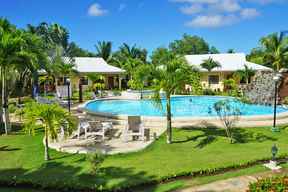
Alona Beach on Panglao Island is the default base for most visitors, packed with dive shops, beach bars, and the widest range of resorts within walking distance of the sand. Dauis, just inland from Alona, offers a quieter, more residential alternative that is still a short tricycle ride from the beach strip. Danao Beach on Panglao's east side trades nightlife for calmer shoreline and fewer crowds. Tagbilaran City itself makes sense mainly for travelers using the ferry terminal or bus station, or an early-morning flight, rather than for a beach-focused stay.
Travel tips for Manila-Tagbilaran
This is a domestic Philippine route, so any government-issued photo ID plus your e-ticket is sufficient at check-in; no passport is required for Filipino travelers. Foreign visitors connecting onward from an international arrival should keep their passport handy regardless, since some hotels in Panglao still ask for it at check-in. Currency and language stay the same throughout, PHP and Filipino/English, and Manila time (UTC+8) applies at both ends with no clock adjustment needed. GCash, Maya, and major cards are widely accepted for hotel and tour bookings in both cities, though smaller Bohol countryside vendors, tricycle rides, and some dive-shop deposits often run cash-only, so carry some PHP in small bills before heading out of Tagbilaran city. Bohol's climate runs warm and humid year-round, roughly 24-32°C, with a wetter stretch from June through November that can affect Loboc River cruise schedules; pack light rain protection if traveling outside the dry season from December to May, and sun protection regardless of when you fly, since UV exposure on Panglao's beaches is intense year-round.
Alternative routes and related destinations
Travelers exploring the Visayas beyond Bohol often add on a Manila-Cebu leg for Mactan's beaches and heritage sites, or a Manila-Caticlan hop for Boracay's white-sand strip. Southbound options include Manila-Davao for Mindanao, while Manila-Iloilo and Manila-Puerto Princesa round out a broader island-hopping itinerary. For a wider view of domestic connections across the archipelago, see the Philippines flight country page.
Why book Manila-Tagbilaran on Traveloka
Traveloka lets you set a Price Alert on this exact route so you get notified the moment fares drop, rather than checking manually across three airlines. Easy Reschedule support helps if Bohol resort plans shift, and local payment options including GCash, Maya, and major Philippine bank cards make checkout straightforward without needing a foreign card.
Flight Information to Bohol
Flight Duration | 1 hr(s) 20 mins |
Airport in Manila | |
Airport in Bohol |
For all your unique travel choices, we got you
Popular Routes from Ninoy Aquino International Airport
Popular Routes from Bohol-Panglao International Airport
Popular Airline to Bohol
Popular Routes
Popular Destinations
Popular Airlines
Popular Airline & Destination
Popular Airports

Popular Airline






























Have your dream trip at your fingertips. Get The App.


